


Scraping massage with tools: gua sha and Graston (Member Post)
Way back in the 2000s, I published a snarky, skeptical article about a popular massage technique.
That article was junk. 🗑️
It was basically correct junk, but a poor piece of science communication — not thorough, meticulous, or classy. I was mostly preaching to a small choir of skeptics and enraging professionals invested in that technique. It was also a reckless full-frontal assault on a specific brand, a legal threat magnet. I was young and pissed off. 😜
So I kicked that trash to the curb ages ago. Rewriting was too big a job, so I dropped the topic in my maybe someday hole — a place many writing goals never escape from.
But that someday has arrived!
This is the second coming of that old article: a substantive and open-minded critical analysis of scraping massage, AKA instrument-assisted soft tissue mobilization (IASTM), or its Chinese ancestor gua sha.
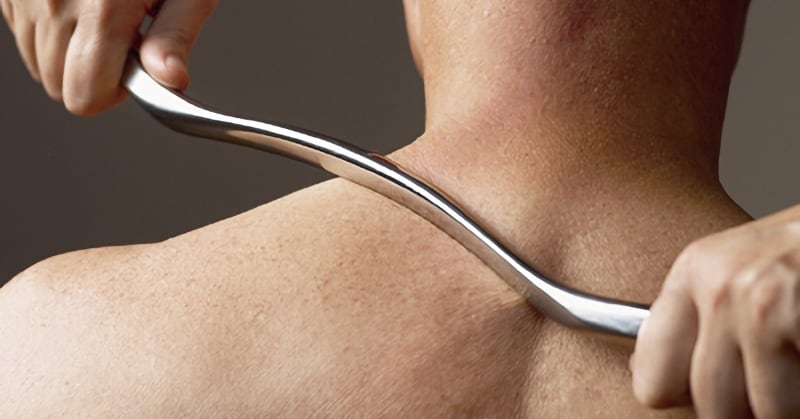
Care for a little scraping massage? The steel massage tools of Graston Technique®.
This post is pointedly not about any specific modality empire. Brands are named but not singled out. This is a tour of the pros and cons of the generic concepts that are the basis for those brands. A distinction without a difference, perhaps? But there is a legal difference, and this is how I do it these days. There is still snarky skepticism (I yam what I yam), but also balance and diplomacy.
And this reincarnated article is members only temporarily — a relatively “safe space” for it for now, but I’ll release it into the wild later this year. Topics in the post:
- Scraping massage big picture
- Gua sha roots: scraping massage as Chinese folk medicine
- Gua sha is not necessarily rough … or superstitious.
- Supposedly advanced western “instrument-assisted soft tissue mobilization”
- What’s it good for? The goals and methods of IASTM
- Safety of scraping massage, especially IASTM
- Can you scrape your pains away? The science report
- 96.5% effective! Success rate claims (and insurance claims)
- Is gua sha a waste of time and money if you like how it feels?
 MEMBERS-ONLY AREA
- “Good” members get all premium posts for $3/month or $30/year, but only by email on publication (new sign-ups will receive the most recent post).
- “Better” and “awesome” members ($5 and $10/month) get much more: web access to all posts and the archives, podcast, full-text RSS feed, and lots of members-only areas in the main PainSci library. For details, see the membership page. ❐
Buy Good, Better, or Awesome PainSci Membership…

Change or cancel plans with ease. Payment data handled safely by Stripe.com. More about security & privacy. PainScience.com is a small publisher in Vancouver, Canada, since 2001. 🇨🇦
The salamander’s domain is for people who are serious about this subject matter. If you are serious — mostly professionals, of course, but many keen patients also sign-up — please support this kind of user-friendly, science-centric journalism.


Scraping massage big picture
Scraping massage is a type of massage therapy with hard-edged tools, often damaging soft tissues and causing bruising: “that’s how you know it’s working.”
Gua sha is the traditional Chinese medicine practice that inspired all the Westernized variants, known as instrument-assisted soft tissue mobilization (IASTM) and mostly represented by Graston Technique — notorious for exotic and wicked-looking stainless steel tools. Scraping massage is a relatively obscure member of the manual therapy family, practiced mainly by chiropractors and massage therapists, and one of the best examples of a provocation therapy that tries to provoke healing with stress.
Although scraping massage is not especially dangerous for healthy people in a clinical context, it’s usually uncomfortable, and there is real potential for harm to many less obviously vulnerable patients (and a few unlucky ones). It’s particularly dangerous as a self-treatment, which is often overzealous; some self-massage tools in this category are notorious for encouraging and enabling abuse.
The cost of professional IASTM is high, the scientific plausibility is low, and the science is pseudo.
On the bright side, the benefits may be implausible, but they aren’t inconceivable — “stimulating” soft tissue assertively might be useful in some cases, and people can experiment cautiously on themselves with little risk to body or wallet. But we should always keep in mind the subtle but very real opportunity cost of using up life energy that could have been used for something much better.
Gua sha roots: scraping massage as Chinese folk medicine
Gua sha is an ancient folk medicine practice in Asia. It is still so popular it is sometimes called “spooning” — because people often do it with spoons!1 Or jar lids! Or coins. Or whatever else is handy.
“Gua sha” (Mando)/ “Gwat sah” (Canto) 刮痧 means, roughly, to “scrape blockage.” But “sha” defies translation, meaning much more than blockage in traditional Chinese medicine (TCM). You could also oversimplify it as “stagnant energy,” “blood stagnation,” or even “toxin,” but all fall short. It’s hard to pack pathogenic substance or energy believed to cause illness into one or two words.
That “substance” or icky energy is revealed by gua sha in the bruising that it causes, like reading tea leaves. Tissue without sha supposedly won’t mark up. The TCM claim is that the appearance of petechiae — a kind of bruise, red spots caused by bleeding into the skin — is diagnostic as well as therapeutic, exposing the culprit while exorcising it.
If that smells fishy to you, you get a gold star!
In the west, gua sha has mostly been dumbed down — we excel at that — to the far simpler claim of being a circulation booster. But neither view is valid.
Like acupuncture, gua sha has spread around the world, surfing on a wave of credulous enthusiasm for anything old, foreign, and exotic-sounding, but especially Asian fetishism. Jonathan Jarry:2
“That is one of the tricks of the wellness industry: selling gadgets and procedures that come from ancient traditions far, far away. There is, after all, an endless supply of folk remedies that can be repackaged for a modern audience suspicious of medicine but desirous of all-natural lotions and potions.”
Gua sha is not necessarily rough … or superstitious.
For many millions of Chinese, gua sha is just a traditional method of self-massage, a kind of “comfort food,” and they don’t think it’s medical magic any more than they think kung fu masters can fly. Obviously many Chinese are among the TCM faithful, but there’s a wide spectrum — many in the middle probably think it’s somewhat healthful, analogous to countless western wellness practices of dubious value.3
I asked massage expert Nicolas Ng about his experience with gua sha:
“My grandma and aunt used to use a porcelain soup spoon and a rice bowl of water. It causes mild redness most of the time, with zero pain in all cases. I remember seeing full bruising once in massage school as a demo, but even that didn’t seem to cause any pain.”
To be clear, the bruising often doesn’t require painful intensity. Bruising is notoriously easy to do without noticing, and even easier painlessly with a hard edge on the skin. My wife has had hundreds of “mystery bruises” in our 25 years together. She can bruise herself by waving a leg in the general direction of a coffee table.4
In fact, the superficial bruising of gua sha is more likely to be painless than painful. But sometimes it does hurt, and that does matter. More on this below.
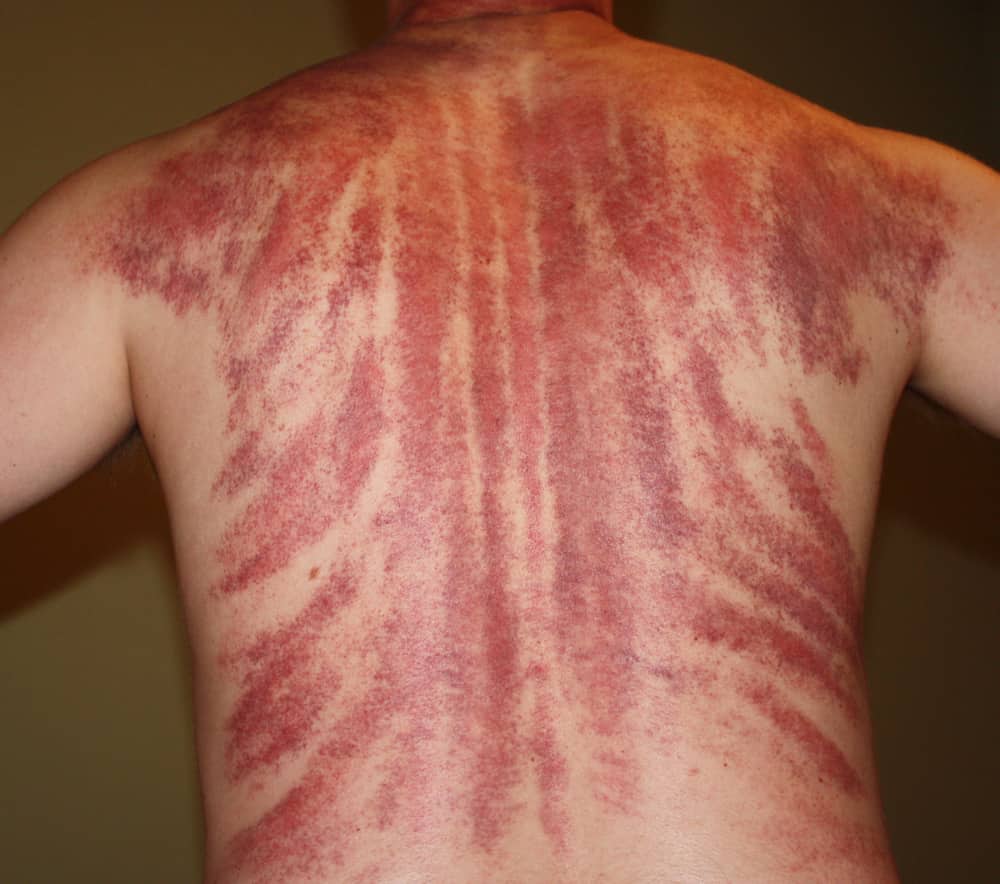
This is the dramatic-looking bruising — petechiae and ecchymosis — that gua sha practitioners typically frame as therapeutic ‘sha’ but is just ruptured capillaries. Photo by Bradwesley69, CC BY-SA 3.0, via Wikimedia Commons. “This is what happens when you get a gua sha massage in rural NC,” the photographer writes.

Supposedly advanced western “instrument-assisted soft tissue mobilization”
Unlike acupuncture, gua sha was also aggressively re-branded and commercialized in the West without invoking “ancient Chinese wisdom,” using a different wellness industry trick: vague pseudoscientific justifications and inevitable claims of superior technique and technology. Fancy scraping tools! First we dumbed it down, and then we junked it up.
Chiropractors were the first to get on the “technological gua sha” bandwagon in North America, where it is now best known as the eponymous Graston Technique,5 but there are a few others (some defunct or close):
- Graston Technique
- Astym®
- HawkGrips (“your gateway to advanced IASTM mastery”!)
- Adhesion Breakers
- FAKTR
- Fascial Abrasion technique
- Técnica Gavilán.
Those are the “clinical” brands, mostly offered by licensed healthcare professionals with specialized training and certifications, and they are collectively known as instrument-assisted soft tissue mobilization (IASTM).
All of these gua sha descendants involve rigid tools — plastic, ceramic, steel, stone, bone, often with a sharp edge — to achieve “maximum tissue penetration.” IASTM is clearly keen on tool quality — they all advertise special qualities and properties: “cutting-edge,” “unique double-beveled design”, a “mirror finish”, a “patented textured surface.”
What’s it good for? The goals and methods of IASTM
The term “instrument-assisted soft tissue mobilization” implies a specific medical purpose, “mobilization,” that mostly isn’t the true point: no soft tissue is ever mobilized in any technical sense. It’s almost poetry, a euphemism for the true goal, not that it’s a secret — the stated goal is to “break down scar tissue and fascial restrictions.” This harmonizes strongly with the pseudoscientific enthusiasm for all things “fascia” — the sheets of connective tissue that wrap everything in anatomy, literally our “gristle,” which is allegedly prone to getting “restricted” and in need of “release.”7
The idea of release, while vague, is the most honest one-word description of the point of IASTM. (See What is a “release” in manual therapy? (Member Post).)
And how do you release it? With tools, by force. You damage it. You tear it. Plenty of fascial therapists insist their methods are gentle, that they aren’t trying to “tear” anything, that they are artfully persuading fascia to loosen up. That isn’t possible, but that’s what they say. But with IASTM tools, there is no hiding behind claims of gentleness: they are intended to damage tissue to one degree or another.
Sorry, they are meant to “mobilize” it!
The fundamentally destructive character of scraping massage is most evident with some self-massage tools. For instance, the faddish FasciaBlaster is a consumer product that is dangerously and successfully marketed mainly as a cosmetic self-treatment for cellulite.8 Cosmetic gua sha has been endorsed by influencers ad nauseam, including — of course — Gwyneth Paltrow, who sells the glossy black Skin Whisperers Obsidian Gua Sha Reformer tool for US $89. 🙄
Safety of scraping massage, especially IASTM
Casual gua sha is often low-key and painless, but it’s not always so tame. And “clinical” scraping massage — IASTM — is routinely applied with painful intensity. Treating pain with painful treatments — fighting fire with fire — is the dubious spirit of all the provocation therapies, and it is always inherently risky to some degree, because the whole point is to “break some eggs to make an omelette.” The damage is mostly minor, but there are a few ways it can go wrong:
- Typical massage has a variety of potential harms, all shared with scraping massage, but it’s mostly the risks of strong massage that are relevant here. However it’s delivered, intense massage involves underestimated risks of muscle damage, especially in common kinds of vulnerable patients.9 Superficial scraping won’t do this — just skin damage, not muscle — but much scraping massage isn’t superficial. It’s impossible to achieve the routinely stated goal of releasing fascial restrictions without also breaking some muscle cells.
- Risks increase when applied to delicate anatomy. Without the sensory detail and intimacy of touch, tools always make it easier to go overboard, but scraping tools are in a different league, requiring even more care — and some practitioners are shockingly careless about where they apply them.10
- Scraping massage has a risk not shared with other massage: a small but real danger of infection, roughly similar to acupuncture.11 Even minor skin scraping carries some infection risk because it compromises multiple layers of defense at once.12 Jonathan Jarry’s description of a case study:13
The risk of infection Nielsen outlines, though, is real and is not the only possible harm from gua sha. You can see that reusing the same stone on multiple patients without disinfecting it is not a good idea. The bruises are under the skin, sure, but tiny cuts may result from the treatment and the stone picks up blood-borne microorganisms and delivers them to the next patient who gets accidentally cut. One such patient was reported on a few years ago: she developed nodules and pustules on her arms and legs, filled with bacteria called Mycobacterium massiliense. She had to be put on antibiotics and have her nodules drained every month for nearly half a year.
Despite these concerns, significant physical harm is still an outlier. But even the discomfort and unpleasantness of IASTM can only be justified by strong evidence of efficacy. It has to work! If it doesn’t, it’s just mild torture. That you pay for. Even confidence in a small benefit wouldn’t cut it. Low-value treatments and over-optimization of health and wellness always have an opportunity cost [Wikipedia] — wasted time/money/attention that people need for better things.
Can you scrape your pains away? The science report
The gua sha roots of IASTM are scientifically weak, if not hopelessly bankrupt. “Gua sha will need more than a spoon or a jar lid to smooth out the many wrinkles in its scientific literature,” writes Jonathan Jarry.14 His rather scathing high-level overview of the research:
“Having read dozens of papers on gua sha, I can say that their failings are exactly what we are used to when it comes to alternative medicine: small studies done at single centres with no long-term follow-up, in which the control group comparison is problematic. Basically, you can’t blind people to gua sha. There is no placebo gua sha that doesn’t also do what gua sha does. Experimenters resort to heating pads, standard of care, or wait lists, which means that at best we can say that doing gua sha can be better than doing nothing. When a patient dealing with chronic pain gets recruited into a study in which a person strokes their body for 15 minutes after being told that this might help with pain, is it any wonder that they report that their pain has gone down? Placebo effects are common, and these studies do not manage to subtract them from the equation.”
Things are no better for IASTM. The “literature” doesn’t really deserve to be called that: it’s unpowered and low quality, useless at best, but arguably worse than useless because it mostly declares undeserved victories, making it more like a promotional exercise than an earnest attempt to figure out what helps people.
In 2025, Tang et al. reviewed 11 trials that met their criteria, six with a particularly high risk of bias. They reported moderate-certainty evidence for pain reduction (SMD=0.60) and low-certainty for function — which sounds good and is technically supported by their data.
But it’s the most charitable possible spin. The truth is hiding in what they chose to review: “selection bias” (cherry picking) has always been the most obvious way to put your thumb on the science scale, and they included only studies of IASTM added to other treatments. They asked the question most likely to produce a positive result. Their conclusion “that IASTM reduces pain” doesn’t tell us that IASTM was the active ingredient! What we want is “moderate certainty that IASTM does anything beyond placebo and extra attention and treatment” … and their data definitely cannot support that. Giving patients more of anything they assume is “the good stuff” basically always produces an effect, regardless. That is by far the most likely explanation for the “positive” results here.15
A 2019 review had similar problems: superficially positive results that just aren’t credible.16
When the literature is this rotten, I like to give a particularly bad example, an especially flawed trial. Today’s winner is one of the less-small trials of IASTM, and any casual reader of the abstract alone could be forgiven for thinking it’s a win for IASTM, but it’s meaningless. The worst of the many problems with this one is that they registered their trial after data collection, largely defeating the purpose of registration.17 Read that footnote for cringe-inducing details.
Fortunately, some researchers have reviewed evidence like that more honestly: one particularly critical 2023 review, by Nazari et al, of 46 mostly junky trials showing no meaningful improvements in function, pain, or range of motion for upper, lower, or spinal conditions:18
“The available evidence on IASTM does not support its use to improve function, pain, or range of motion”
And what’s “available” is only “very-low quality evidence for all the included outcomes,” and worse still, “the publication of IASTM trials in suspected predatory journals is increasing.” So the review doesn’t so much conclude that IASTM no worky as IASTM research just sucks — but that is actually a damning signal by itself in the context of a lot of bias. Dozens of trials biased in favour of a treatment that actually works will never fail to find its effect.19
An earlier honest review by Cheatham et al. concluded:20
The current research has indicated insignificant results which challenges the efficacy of IASTM as a treatment for common musculoskeletal pathology.
Even some IASTM proponents have conceded the gap between bold claims and thin evidence.21
96.5% effective! Success rate claims (and insurance claims)
Claims of high success rates are almost nonsense by definition. For instance, as of early 2026, Astym.com prominently claims a 96.5% success rate — an amusingly large and precise number, and a huge red flag for any thinking person. Any such claim is a marketing claim, not a scientific one. Unfortunately, that’s what drives most of this industry.
Such claims are routine for IASTM. But “success rates” aren’t something individual clinicians can know, and even if they could, it wouldn’t validate anything — there are far too many confounders.22
Speaking of “claims”: insurance coverage is also often treated/touted like a kind of evidence: it must work, or insurers wouldn’t pay for it. IASTM is probably rarely specifically paid for by insurers, but it is almost certainly covered by an umbrella of manual therapy insurance in some places, both public and private — probably not specifically, but as a component of “massage/manual therapy” at the clinician’s discretion.23
Even if insurers were willing to pay specifically for IASTM, that choice does not validate scraping massage in any way, because insurance is not evidence.
Is gua sha a waste of time and money if you like how it feels?
People are entitled to spend their resources on whatever they like, of course. But everyone else is also entitled to question their judgement. 😜
People can put value on anything they like — a basic principle of life and economics, the subjective theory of value. Value isn’t automatic for anything, not even gold or diamonds — it is always bestowed by our preferences and priorities. In this sense, we can never “waste” our money on things we want.
Unless we want them for silly reasons. What if what we want is wishful thinking?
It’s a bit of a reach to place value on the mere “feeling” of scraping massage. What people actually like is the idea that it’s therapeutic. Subtract that belief, and the value vanishes! The feeling alone isn’t enough.
What about nostalgia? Even the comforting familiarity of gua sha probably isn’t enough after the illusion of medical benefit is broken. How many people are going to do it just because their mother showed them how when they were ten? A few, I suppose, but not many.
Done in the bruising, scar-busting spirit of the thing, it clearly isn’t inherently pleasant. (Yes, I have tried.) And if you aren’t doing it that hard, it’s just a suboptimal form of massage. Either way, it’s not intrinsically pleasant, and how it feels only has whatever value and meaning people can gin up in spite of that. It has to be rationalized.
And those rationalizations are weak.
I will always avoid yucking anyone’s yum24 if it isn’t particularly problematic and the reasons are respectable. But it’s a spectrum, and at some point I’m going to start expressing my concerns. People will value things for bad reasons, and skeptics will point out that the reasons are bad. And it will continue to amaze me that so many people are so willing to risk throwing away substantial amounts of time and money. You’d think that would be more of a disincentive than it actually is! But clearly we are a very wasteful species.
Notes
- Lam CT, Tse SH, Chan ST, Tam JK, Yuen JWM. A survey on the prevalence and utilization characteristics of gua sha in the Hong Kong community. Complement Ther Med. 2015 Feb;23(1):46–54. PubMed 25637152 ❐ Nearly a quarter of 2300 surveyed Hong Kong citizen used gua sha in the previous year. Their preferred tool for the technique? A spoon!
- McGill.ca Office for Science & Society [Internet]. Jarry J. Gua Sha Is Exotic Wellness That Leaves a Mark; 2026 Jan 9 [cited 26 Jan 14]. PainSci Bibliography 49396 ❐
- Lam CT, Tse SH, Chan ST, Tam JK, Yuen JWM. A survey on the prevalence and utilization characteristics of gua sha in the Hong Kong community. Complement Ther Med. 2015 Feb;23(1):46–54. PubMed 25637152 ❐ Lam et al reported that 74% of surveyed Hong Kong gua sha users thought they were treating pain or, oddly, respiratory problems. There was also a long tail of other candidates: anxiety, heat stroke, fever, infection, dizziness, diarrhoea and vomiting, oedema, and constipation. Bad idea to rely on gua sha for some of those! But the survey data didn’t show us how *much* faith they had in those goals.
- Bruising susceptibility varies widely, with very low thresholds for many people and many reasons. Aging skin is notoriously bruise-prone, thanks to dermatoporosis (age-related skin fragility). Hypermobile Ehlers–Danlos syndrome (hEDS and the other hypermobility spectrum disorders all involve inherent fragility of capillaries and supporting structures. Vitamin C deficiency (scurvy) weakens collagen and vessel integrity. Anticoagulant therapy and corticosteroid use either impair clotting or thin the skin, and there are many other drugs with bruising side effects: SSRIs/SNRIs (fluoxetine, sertraline, venlafaxine), NSAIDs (ibuprofen, naproxen), fish oil (omega-3 supplements), vitamin E, chemotherapy and targeted cancer therapies, and … alcohol!
- Graston Technique is occasionally described as a chiropractor’s invention, which seems false on its face, while still potentially true in spirit. That is, it was not “invented” by a chiropractor, but probably developed as a business by chiropractors. David Graston was not a chiropractor but an amateur athlete. I have not been able to confirm this, but he may have worked quite closely with chiropractors to promote Graston Technique. Regardless of how it happened, it has become one of the larger manual therapy modality brands of the last few decades, and is practiced mainly by chiropractors.
- Friction massage belongs in the provocation therapy category but is simpler, safer, and cheaper, and rests on more focused and restrained claims that might make some sense (even though it’s far from proven medicine). Friction massage is mainly a treatment for tendinitis, rubbing its fibres with fingers, not tools. If it works, the mechanism is probably mild stimulation of natural tissue repair processes. See my full review: Deep Friction Massage Therapy for Tendinitis: A guide to a simple self-massage technique sometimes helpful in treating common tendinitis injuries like tennis elbow or Achilles tendinitis.
- Fascia is widely considered an exciting frontier in manual therapy, and is particularly embraced by massage therapists. The big idea is that fascia — sheets and webs of connective tissue found throughout the body, literally the gristle in our meat — can get tight and needs to be “released” by pulling on it forcefully and/or artfully. Unfortunately, although fascia biology is interesting, the stuff has no properties that are relevant to hands-on therapy. Fascia research is plentiful but mostly amateurish and pseudoscientific and clearly fails to support “fascial therapy.” Enthusiasm about fascia is an unjustified fad. See Does Fascia Matter? A detailed critical analysis of the clinical relevance of fascia science and fascia properties.
- The FasciaBlaster [wikipedia] has multiple hard plastic “claws” used to rub over the skin. Bruising is common regardless of whether the manufacturer endorses it. The kindest thing you can say is that it lacks scientific support or even plausibility, but many criticisms are harsher: the company, product, and its harms have been strongly reviewed, and several legal battles have already been fought over it since its debut in the mid 2010s.
- Sometimes we feel cruddy after a massage, like it was a big workout. Post-massage soreness and malaise (PMSM) is embraced as a minor side effect and hand-waved away by almost everyone as some kind of no-pain-no-gain or “healing crisis” thing. But it needs explaining! Massage is not “detoxifying” in any way (that’s pseudoscientific nonsense). Ironically, it may be the opposite: some PMSM is probably caused by mild rhabdomyolysis, a type of poisoning that can occur even with heavy exercise … and possibly strong massage, which is a plausible hypothesis. If so, it’s a big deal, a nasty side effect. There are also some non-rhabdo explanations for milder PMSM. See Poisoned by Massage: Rather than being DE-toxifying, deep tissue massage may actually cause a toxic situation.
- Tsai KK, Wang CH. Acute epiglottitis following traditional Chinese gua sha therapy. CMAJ. 2014 May;186(8):E298. PubMed 24277709 ❐ PainSci Bibliography 49402 ❐
You’d think people would know better than to scrape over structures like, say, the throat and trachea — but no! One patient had gua sha performed on his throat, which alarmingly inflamed his epiglottis, making it difficult for him to speak. His inflammation resolved quickly with intravenous steroids, but yikes! Clearly that scraping was done hard enough to affect deeper tissues, and obviously gua sha practitioners should know better, but, as Jonathan Jarry notes, “When a practice is unregulated and becomes popular, you never know how well trained the person caring for you is.” What’s next? Testicular scraping? Eyeballs? Sheesh!
- Acupuncture always breaks the barrier of the skin, but minimally, and usually with adequate infection control (disinfectant, gloves). Scraping massage does less damage in one spot, but damages a lot more skin area, and technique varies widely — much of it too aggressive, sometimes doing much more damage.
- The outer skin (stratum corneum and epidermis) is a highly effective infection barrier, by far our most important. Even shallow scrapes allow some microbes direct entry, reaching the dermis without technically “breaking the skin” like a needle would. Scraping disrupts the relatively dry, acidic outer layers that contain antimicrobial peptides. Scraping also disrupts cells and small vessels, triggering inflammation that recruits immune defenses — but opening a transient window for microbes to get a foothold. Tools are rarely completely sterile. And there are all kinds of subtle immune impairments patients are probably oblivious to.
- Park SW, Kwak HB, Lee SK, et al. Cutaneous Mycobacterium massiliense Infection Caused by Skin Coining 'Gua Sha' in Korean Healthy Female. Ann Dermatol. 2021 Dec;33(6):572–576. PubMed 34858010 ❐ PainSci Bibliography 49397 ❐
- Jarry 2026, op. cit.
- Tang S, Sheng L, Wei X, et al. The effectiveness of instrument-assisted soft tissue mobilization on pain and function in patients with musculoskeletal disorders: a systematic review and meta-analysis. BMC Musculoskelet Disord. 2025 Mar;26(1):257. PubMed 40087631 ❐ PainSci Bibliography 49187 ❐
- Seffrin CB, Cattano NM, Reed MA, Gardiner-Shires AM. Instrument-Assisted Soft Tissue Mobilization: A Systematic Review and Effect-Size Analysis. J Athl Train. 2019 Jul;54(7):808–821. PubMed 31322903 ❐ PainSci Bibliography 49185 ❐
This 2019 systematic review with effect-size analysis examined 13 randomized controlled trials of instrument-assisted soft tissue mobilization (IASTM) or “scraping massage.” Study subjects range from healthy athletes to patients with conditions like tennis elbow, carpal tunnel syndrome, and Achilles tendinopathy.
The reported result is that IASTM showed large effect sizes for improving range of motion in uninjured people (mostly shoulder mobility in overhead athletes), and for reducing pain and improving self-reported function in injured patients, particularly those with tendinopathies. (Strength gains? Not so much — effect sizes were small and inconsistent. Why would anyone think any kind of massage would improve strength?)
I flat-out don’t believe it, and there are very good reasons for my skepticism.
This is classic "garbage in, garbage out." The average study quality was middling at best, and that's being generous because blinding was poor across the board, which is notorious specifically for inflating effect sizes. The authors also couldn't calculate traditional between-group effect sizes because the study designs varied so wildly — they had to use pre-post comparisons instead, which is a weaker approach that can flatter interventions. In other words, they were effectively making one of the most classic and basic statistical errors in the business: touting results based on fundamentally the wrong comparison, the "within-group fallacy" wearing a slightly fancier hat. The hat doesn't help. The authors actually acknowledge this! But their caveat is hugely understated, while the abstract and conclusions read as though the evidence is fairly supportive. The mismatch between the methodological fine print and the confident tone of the recommendations is a serious problem for their credibility.
These are catastrophic validity problems that aren't reflected in the merely mediocre PEDro quality ratings for the trials.
In short, this review is largely worthless.
An interesting wrinkle: the different brand-name tools all produced similar results, which rather undercuts the marketing claims of any particular scraping gadget. The authors themselves note that a homemade tool might work just as well — a refreshingly honest observation for this literature.
- Islam MA, Ahmed F, Hossain KMA, et al. Efficacy of instrument-assisted soft tissue mobilization technique for patients with chronic low back pain: a randomized clinical trial. Bulletin of Faculty of Physical Therapy. 2025;30(1):44. PainSci Bibliography 49186 ❐
This small Bangladeshi randomized trial (n=52) tested whether adding IASTM scraping tools to standard physiotherapy helps chronic low back pain more than physiotherapy alone. This is one of the only RCTs with half decent sample size in recent years — but it’s still small. And disastrously flawed. You don’t even have to read the "fine print" to know that this one is junk. There are many problems here, and the first alone is a deal-breaker:
- The trial was registered after data collection was completed — completely defeating the point of registration in the first place. There is no justification for this. It’s incompetence at best, fraudulent at worst.
- Effect sizes were not reported, leaving the clinical meaning of those group differences unclear.
- The sample is small and drawn from a single clinic in Bangladesh, limiting generalizability.
- There was no sham or placebo control, so patients knew which treatment they were getting; the "better" group received more hands-on contact time, which is a classic confounder.
- Several references in the paper are bizarrely mismatched to their citation context (a coronavirus paper cited for LBP epidemiology; a paper on beef price transmission cited for IASTM mechanisms), suggesting careless scholarship at best.
For what it’s worth: patients got 12 sessions over four weeks, and Islam et al. report that the IASTM group did better on pain, range of motion, and disability. But it’s worth nothing. Seriously, studies like this are not just worthless, they just muddy the waters and devalue science.
- Nazari G, Bobos P, Lu SZ, et al. Effectiveness of instrument-assisted soft tissue mobilization for the management of upper body, lower body, and spinal conditions. An updated systematic review with meta-analyses. Disabil Rehabil. 2023 May;45(10):1608–1618. PubMed 35611579 ❐
- Reviews like this are technically reporting only an absence of evidence that, in a better world, would just mean “we don’t know.” But in a messy world with broken peer review, a low quality body of evidence with a high risk of bias will never deliver evidence of absence — because so many biased researchers will predictably p-hack their way to results that they can spin as “promising,” always just enough that they can plausibly say “more study needed.” If there was any good treatment effect to find, these trials would not only have found it, they would have exaggerated it. But what they found wasn’t even impressive with the inevitable inflation of results that bias causes!
- Cheatham SW, Lee M, Cain M, Baker R. The efficacy of instrument-assisted soft tissue mobilization: a systematic review. J Can Chiropr Assoc. 2016 Sep;60(3):200–211. PubMed 27713575 ❐ PainSci Bibliography 53642 ❐
This is the first review of studies of an unusual and controversial massage technique: using tools to “scrape” soft tissue. The authors evaluated seven studies, five of which were controlled, and “the results of the studies were insignificant with both groups displaying equal outcomes.” Although there’s not much good evidence to review, the research so far “challenges the efficacy of IASTM as a treatment for common musculoskeletal pathology.”
One slightly positive note was that there is “some evidence supporting its ability to increase short term joint ROM,” for whatever it’s worth (not much — short term increases in ROM have no clear clinical value in and of themselves). As always, more study is needed, and some benefits might be discovered by studying the right people in the right way, but the first several tests have failed to show any obvious benefit.
- Dynamicprinciples.wordpress.com [Internet]. Van Gelder L. What IASTM is, is not, and might be; 2013 Mar 20 [cited 14 Sep 23]. PainSci Bibliography 54746 ❐ Leonard Van Gelder, a self-described “huge advocate of IASTM,” but apparently a critical thinker: “There are some who have purported [IASTM] tools as being downright magical in their abilities to ‘heal’ patients. Some major brands claim 80-100% success rates for nearly every musculoskeletal condition under the sun, but record and maintain these records privately, available on request only. From the published experimental study realm, far less data is available.”
- Self-serving claims are common in fee-for-service manual therapy — freelance therapists tend to overpromise — and almost always conflate customer satisfaction with efficacy. People want to feel they’re getting their money’s worth and avoid admitting dissatisfaction. Most clinicians grossly underestimate how misleading this combination is. Claims of high success rates are delusions of grandeur, and ironically exemplify the kind of arrogance that alt-med professionals condemn in medicine. Amazing results are mostly impossible in healthcare: most painful problems are the tip of an etiological iceberg, and genetic variation alone tends to guarantee treatment failures.
- New York insurer HMS: “While the Graston Technique itself is not a billable code, the manual therapy techniques performed with the instrument (e.g., soft tissue mobilization, myofascial release) can be billed under 97140,” which covers “a variety of hands-on treatments that aim to improve function, reduce pain, and enhance mobility.”
- I think the language construct of “yucking” someone’s “yum” is an internet riff on a snippet from a Tom Robbins novel, Still Life With Woodpecker: “There are only two mantras, yum and yuck; mine is yum.” But that was just a simple dichotomy. It was adapted on social media in the 2010s as a way to tell people not to disrespect other peoples' tastes or pleasures.