


Why is it so hard to get good help for pain? Part 3 (Member Post)
Welcome to the third and final instalment of my series about why so many people with chronic pain are frustrated with healthcare — especially if they have unexplained pain (fibromyalgia), or more obvious pain that is inexplicably stubborn (like frozen shoulder or Achilles tendinitis that drags on for years).
Today I’ll cover the last five of the original list of fifteen — which I could easily expand to twenty. Or twenty-five! But I need to move on to other projects for now!
Trigger warning for professionals: This series is a strong critique of what’s wrong with healthcare for pain, and so of course it gets quite “negative,” and some of these points may be hard to hear. Not all pros are responsible for all of these problems, of course. And I like to think that my work attracts a better class of clinicians, more comfortable with controversy. In any case, I hope you’ll appreciate the insight into how your work may be perceived by frustrated patients.
The story so far, in Part 1:
- Pain is an extremely hard problem
- There’s not enough good science about pain
- Pain is too easy to ignore, trivialize, and blame on the mind (especially in a world full of prejudice)
- Lack of medical leadership
- Specialists aren’t very special if you aren’t their kind of patient
And Part 2:
- The opioid war is catastrophic for pain patients
- Professional pride, tribalism, investment, and the corrupting power of profit
- Academic and intellectual weakness
- Rank quackery, icky snake oil, and flaky bullshit
- Tech as sneaky quackery
There have been facepalms throughout this series, but today it’s time for some of the biggest of them all: major themes and paradigms that undermine pain care.
And now Part 3:
- Insurance-based medicine
- Wellness, bio-hacking, and supplements
- The shabby old paradigm of “structuralism”
- A shiny new generation of mind-blamers
- Pain is a job for a kind of healthcare that barely exists
And there is a more optimistic follow-up — free for everyone — to chase away some of the doom and gloom: Ideas for improving pain care.
The final five reasons it’s hard to get good help for pain …
 MEMBERS-ONLY AREA
To read all the reasons, become a member of the cynical salamander fan club …
- “Good” members get all premium posts for $3/month or $30/year, but only by email on publication (new sign-ups will receive the most recent post).
- “Better” and “awesome” members ($5 and $10/month) get much more: web access to all posts and the archives, podcast, full-text RSS feed, and lots of members-only areas in the main PainSci library. For details, see the membership page. ❐
If you join now, will you get parts 1 and 2? Yes. Signing up for the basic plan (eg $3/month) doesn’t normally get you past posts (just new ones as they are published), but I’m making an exception for this: I’ll send the whole why-so-hard series to anyone who joins through Oct 17, 2025.
Buy Good, Better, or Awesome PainSci Membership…

Change or cancel plans with ease. Payment data handled safely by Stripe.com. More about security & privacy. PainScience.com is a small publisher in Vancouver, Canada, since 2001. 🇨🇦
The salamander’s domain is for people who are serious about this subject matter. If you are serious — mostly professionals, of course, but many keen patients also sign-up — please support this kind of user-friendly, science-centric journalism.

11. Insurance-based medicine
There are many reasons why professionals sell treatments for pain for reasons other than efficacy, but one of the mightiest and worst is because insurance will pay for it. Whole courses of treatment happen mainly because there’s insurance money for it; entire careers can be based on what insurance will cover. It’s not always a bad thing, of course, but insurance-based medicine isn’t nicely aligned with evidence-based medicine. And that surprises people!
Both patients and pros tend to assume that medical insurance companies are so savvy, mercenary, and parsimonious that they would never be willing to pay for ineffective health services — and this is often used as a substitute for scientific evidence. Surely such tight-fisted corporations wouldn’t pay for useless treatments? Right? Therefore [insured bullshit] must work!
No! 🤦🏻♂️ That is not how any of this works. Insurers don’t have secret knowledge of the efficacy of unproven treatments, they are not “ahead of the science,” and you cannot “follow the money” to what works. If you follow the money more cynically, it leads to things like the eagerness of insurers to pay for relatively inexpensive bullshit treatments… in lieu of much more expensive ones that are more effective.
But it’s worse for pain patients, because there aren't that many treatments that are evidence-based in the first place. Knowledge gaps tend to be filled with snake oil … and then insurance pays for it, legitimizing and entrenching it. Few things fossilize bad and obsolete ideas as effectively as the flow of insurance money.

Massage is one of the best examples of healthcare that is legitimized and facilitated by insurance money in the absence of evidence that it is an effective treatment. This is not to say that it offers no pain relief (that’s a separate question, although there are many reasons for pessimism). The insurance dollars mainly mean that many customers want it … not that they benefit medically from it.
12. Wellness, bio-hacking, and supplements
“Bio-hacking” is an informal term for DIY health “optimization” with experimental and often fringe medical practices. I’m mostly concerned here with the more extreme examples, and how common they have become: nutritional regimens (ketogenic and fasting); experimental uses of drugs and hormones (e.g. nootropics, psychedelics); tinkering with the gut microbiome. But by far the most important thing in the bio-hacking toolkit?
Supplements, of course: the single biggest type of alternative healthcare, probably bigger than all the rest put together. People love to hate Big Pharma, but are surprisingly willing to embrace “Big Suppla” — even though it has been every bit as powerful and corrupt as Big Pharma in the 21st Century, while also being virtually unregulated.
Big Suppla arguably gave birth to bio-hacking by hard-selling the idea that we can improve our physiology without a prescription from the doctor … and now bio-hacking is giving back to that industry generously, constantly encouraging more, and more radical, experimentation, mostly with what amounts to untested drugs.
But if bio-hacking is mainly a grass roots movement devoted to self-care, how has it become a reason that pain patients “can’t get good help”? Bio-hacking has polluted the whole field, dragging us all towards amateurism, cowboy medicine, and ever more radical health fads. Many bio-hackers have become influential cranks, extremists, and ideologues who are aggressively normalizing fringe views and ideas. Many alt-med professionals have set themselves up as bio-hacking gurus and guides, and are milking the “influencer” economy hard. And all this noise gives cover to more mainstream sources that want to profit from sketchier products and services. Stem cell therapy clinics, for instance, are notoriously unethical, racing well ahead of the science — but they now seem relatively tame.

The supplements industry packages hope in bottles, and very little else. It’s shocking how successfully consumers have been convinced that there actually is hope in there. But the deeper story? Supplements give lots of cover for much worse quackery by normalizing wishful thinking.
13. The shabby old paradigm of “structuralism”
Structuralism is the excessive focus on abnormal anatomy, posture, and movement as causes of pain, despite abundant evidence that they don’t matter much. Far too many professionals send patients on wild goose chases to fix things like lazy glutes and pelvic tilts, convincing them that they are like a fragile machine that quickly breaks down when it’s out of alignment.
It’s impossible to overstate the dominance of this way of thinking about therapy. Whole professions are based on it, most obviously chiropractic and massage therapy, defined by their fixation on “fixing” bodies with hands and tools, and especially by aligning and straightening. You can still pay a massage therapist a dollar a minute for a bogus postural scan, or a chiropractor (even “one of the good ones”) to inspect your spine for imaginary glitches.
But structuralism haunts the whole industry. All kinds of pain pros are prone to pathologizing every conceivable kinesiological abnormality or variation, from pronation and patellar maltracking to fascial distortions and scapular dyskinesias. One major physical therapy brand is devoted to detecting subtle, injurious movement patterns. There's a crank theory that a tiny foot bone can somehow cause trouble from toe to head. The most overrated and popular bogeyman in the business is still “core” weakness, somehow responsible for virtually all back pain and much more. And of course there are countless claims of disabling tightness in various bits of soft tissue.
This is why people fully expect physical therapy to involve many tedious “corrective” exercises for such problems — almost none of which has ever been useful.
Many examples of structuralism are easy to mock, but it can also seem sophisticated. Kinesiology, the science of movement, has churned out countless studies that inflate these ideas. Much of it is pseudoscientific barking up the wrong tree, based on very old and simplistic assumptions about the nature of injury and pain.
Structuralism is all about blaming things we can easily see or imagine, while ignoring the much messier biology that matters, and even basic but boring clinical wisdom. For instance, load management is often sabotaged by overzealous therapeutic exercise prescriptions, instead of just resting and progressing slowly. “Baby steps” are the building blocks of most rehab, but it’s hard to sell them, and therapists need to justify their fees. And so structuralism is also all about making up problems with solutions that therapists can sell.
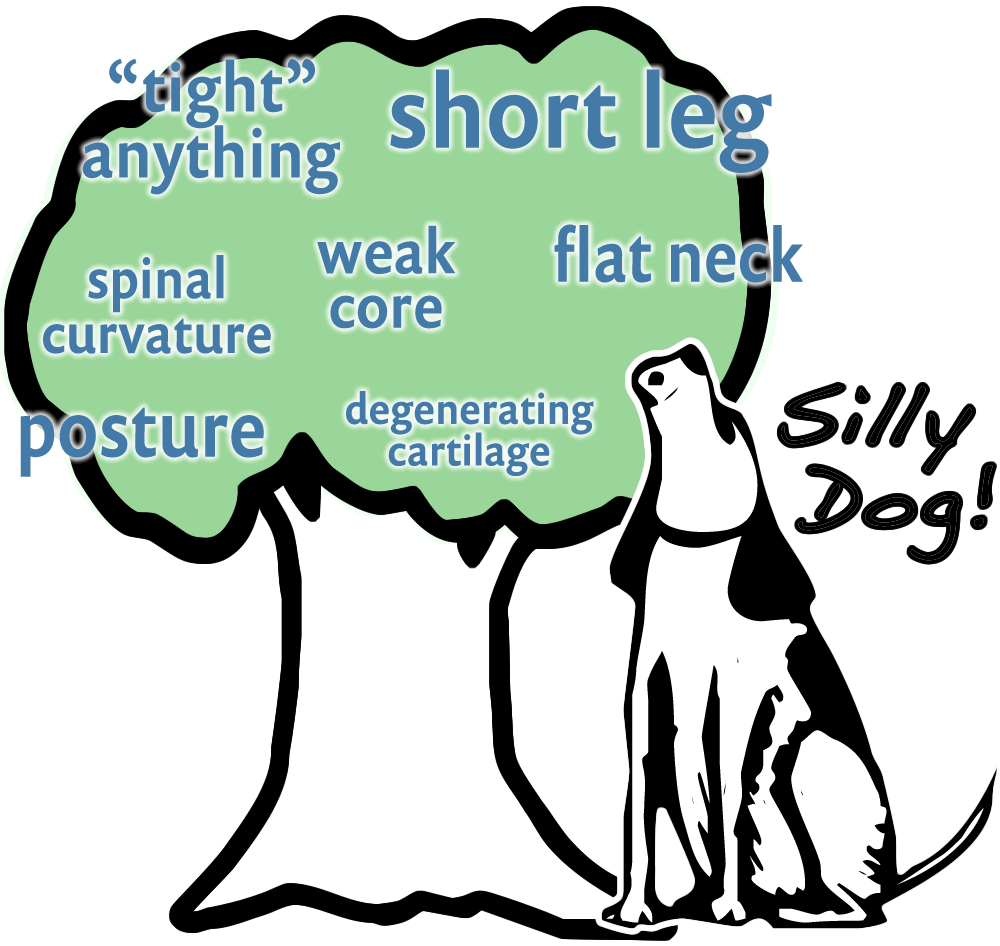
The science of human movement (kinesiology) has given clinicians little of value for helping patients with chronic pain. It has mostly been a multi-decade boondoggle.
14. A shiny new generation of mind-blamers
Early in this series, I wrote that pain is “too easy to ignore, trivialize, and blame on the mind” — but that was about laziness, ignorance, and prejudice. Many professionals blame the mind so much more intentionally and elaborately that it’s a different problem. They believe that pain is a psychological problem with psychological solutions — and most will bend over backwards to deny that this is an “all in your head” diagnosis with a fresh coat of science paint.
Ironically, much of this is due to admirable efforts to disavow and replace structuralism. But many clinicians have jumped from the frying pan of simplistic biomechanics into the fire of simplistic psychology, pushing mental “misalignment” instead of physical. It’s not your spine that’s out of line, it’s your mind!
At best, the perspective has some merit (especially for helping people with suffering and disability rather than treating the pain itself). But the role of psychology is often distorted and overemphasized in practice, displacing proper diagnosis and treatment. This is often indistinguishable from gaslighting.
At worst, it’s just wrong. Even if the mind does influence pain, that doesn’t necessarily mean we can think our way out of it. The evidence for this allegedly progressive revolution in pain care is shockingly thin. There are many examples of passionately held beliefs about the psychology of pain that are highly dubious: CBT works! Placebo is powerful! Pain can be “learned”! Boot-nail guy is a great example!
And many more.
Mind-over-pain ideas are surging in popularity in physical medicine, championed by many popular influencers. It’s still dwarfed by the reigning heavyweight champion, but it has much greater symbolic importance, because it is being touted by so many professionals as the way forward.
Meet the new boss, just like the old boss.
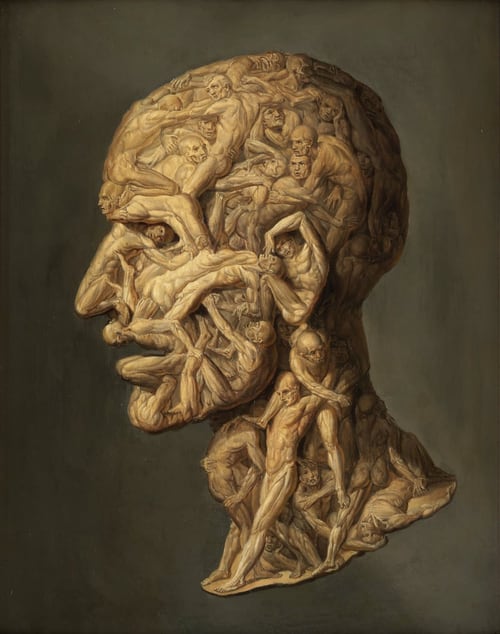
Can the mind create or amplify pain? A whole new generation of clinicians is investing in that surprisingly weak hypothesis. Ironically, despite near universal loathing for the words “all in your head,” almost everyone does also believe that it is possible for pain to be psychogenic, and mindbody medicine is a smash cultural hit. A painful paradox!
15. Pain is a job for a kind of healthcare that barely exists
I started my career criticizing some of the most obvious pseudoscience and quackery available for pain patients, like Epsom salts and homeopathic arnica and posturology. The most common “criticism” in my inboxes ever since has been “so what does work, smartypants?” Because a critic isn’t credible if they can’t replace bad answers with good ones, apparently.
The whole reason that pain treatment is dominated by deeply flawed and simplistic solutions is that there are so few real solutions. Providing “good help” to pain patients requires knowledge, skills, and tools that either literally don’t exist at all — because we just do not have the science — or are just out of reach of most clinicians for many reasons.
A practical example is diagnosis. A lot of chronic pain isn’t so much medically exotic as it’s just a needle in a haystack. Those patients need Dr. Greg House, MD, and his whole team of fantasy physicians to find that needle. This applies even to many seemingly simpler problems, like unusually stubborn tendinitis, which often has metabolic roots — a perspective most healthcare professionals don’t know enough to even consider.
The existing culture and economics of physical and pain medicine is not prepared for the challenge, for all of the reasons covered in this series and more besides. The current marketplace mostly offers only basic answers to one of the most complex problems in medicine. The knowledge and skills that are actually needed are extremely difficult to learn and apply, and broadly require the tools and culture of medicine and medical science, but then even more besides: time, compassion, creativity, intellectual honesty, critical thinking skills, healthy economic incentives!
Even just the education and systemic support required is more than most non-doctors have, or are likely to ever acquire … assuming they even wanted to. It is not what most of them “signed up for.” Many just wanted to be “body mechanics,” not biochemists.
Pain is a job for a kind of healthcare that not only mostly doesn’t exist, but cannot exist without major systemic change.
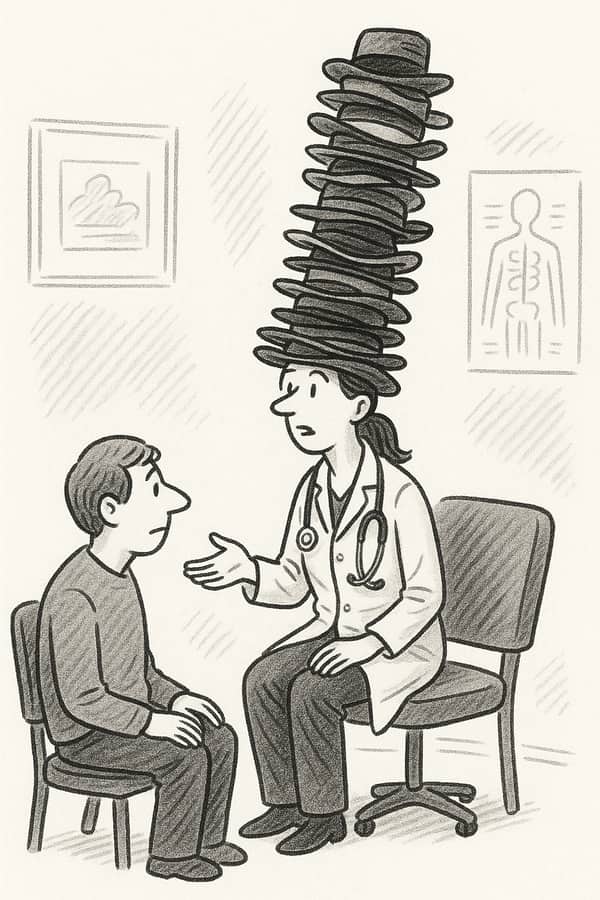
Good care for chronic pain requires healthcare professionals to wear “too many hats” — more hats than is realistically possible … even they wanted to, which most don’t. Pain needs a different kind of healthcare, complex and nuanced and probably multidisciplinary, which is why “pain clinics” exist — but they are mostly quite disappointing in practice.
Can I end on a high note?
I originally planned to finish this series with a good list of constructive suggestions for how to move the field forward despite all of these problems. No pressure! But this project has been such a beast — so many ideas to wrangle — that in the end I decided to save that optimistic heavy lifting for another day.
I will try to conclude with one optimistic note, however: what is true of “most” pain care, no matter how daunting and depressing, doesn’t have to be discouraging for individual clinicians.
If you’re a professional, you can still be a breath of fresh air for your patients. And there is plenty of low-hanging fruit. Clearly you don’t have to go to medical school to be compassionate, respectful, humble. And you don’t have to be a genius diagnostician to recognize and reject ridiculous theories about the causes of pain, for instance. But you do need some critical thinking skills, and some science literacy, and every kind of healthcare professional should be aspiring to that — another quite achievable goal! There’s a book for that. (No, not one of mine, although I’d like to think they are indeed quite helpful in that way.)
See Reassurance for Massage Therapists — it has several more constructive suggestions for how manual therapists can be of service.
And if you’re patient, you can at least improve your odds of finding one of these idealistic mavericks. And forewarned is forearmed: you can spot red flags that other patients have never even heard of. You can save time and money not chasing wild geese, if nothing else.