


Physical therapy is still dominated by one big, wrong idea
Despite so many advances in the science of aches, pains, and injuries over the last twenty years, as of 2024 I still see the same depressing thing that most worried me the most when I was just starting out in this field a quarter century ago: clear signs of extreme oversimplification, and a lack of respect for the dizzying complexity of physiology.
Exhibit A: My inbox overflows with messages from professionals that place an almost comically simplistic emphasis on posture… as if it were the only etiological idea they’ve ever been exposed to, the only way that they can imagine the human body hurting that they ever really took seriously.
There are many riffs on the tune of “structuralism” — too much focus on biomechanics — but poor posture is by far the biggest. Even when obfuscated by fancy-sounding jargon, every version of this way of thinking boils down to this claim: “crookedness and other slight biomechanical imperfections wear you down and eventually cause pain and injury.”
Or even more simply: “People hurt because they are crooked.”
Empires have been built on that! But the whole paradigm is mostly bogus, a vast house of cards. (If you’re unfamiliar with the arguments against it, I spell them out in great detail in Does Posture Matter? A detailed guide to posture and postural correction strategies (especially why none of it matters very much). This little rant got written while I was doing some editing of that article.)
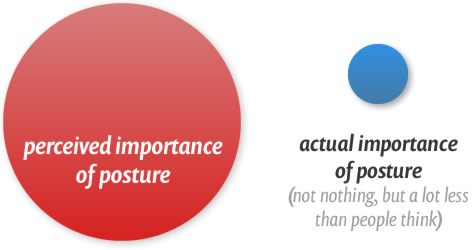
Posture isn’t completely irrelevant to pain, it’s just dramatically less relevant than the therapy industry has made it out to be.
Not just a thriving subculture — posture still dominates
My point today is that this bogus view of how pain works is not just some thriving little subculture: it actually continues to dominate manual therapy. It is king.
Physio, massage, chiropractic, and others are still largely defined by structuralism in general, and posturology in particular. Millions of professionals remain simplistically fixated on posture and other kinds of asymmetries at the expense of almost everything else that might matter in the management of pain and injury — which is plenty! Think messy, dizzyingly complex physiology, and especially immunology/inflammation.1
It’s impossible to overstate how prevalent posture-worship still is, or how antiquated it has gotten while continuing to gobble up mindshare. This is not just a common pattern of thinking, but remains the conceptual foundation for major therapy brands, products, and even entire professions. (And you can easily guess which professions are pretty much defined by the quest for “alignment.”)
You can observe the power of posture any day of the week on social media, which produces a torrent of freakishly popular posture worship — like posts demonizing text neck that net a hojillion likes and supportive comments. It’s an infinite display of enthusiasm for simplistic answers that dwarfs any flicker of awareness of the more nuanced reality.
We just can’t seem to get past this. Progressive voices, encouraging people to think about the challenge of pain in a more nuanced and scientific way, are like a candle in a dark cathedral devoted to the worship of simplistic, “mechanical,” and fanciful causes of pain and injury.
Most pain has much more to do with biochemistry, physiology, and the behaviour of cells than how we sit, stand, and move.
Notes
- There are countless good examples of how pain is more about biochemistry than biomechanics, but one of my favourites is frozen shoulder — because it’s an extremely common and painful problem, often blamed on poor posture and "dyskinesia" (bad movement) of the shoulder, when the truth is that it’s mainly a genetically mediated pathology affecting connective tissue metabolism, which is biologically related to Dupuytren’s contracture (hand deforming) and Peyronie’s disease (penis-deforming). So good luck fixing that by standing up straighter.