


Pain needs nociception: 3 new papers
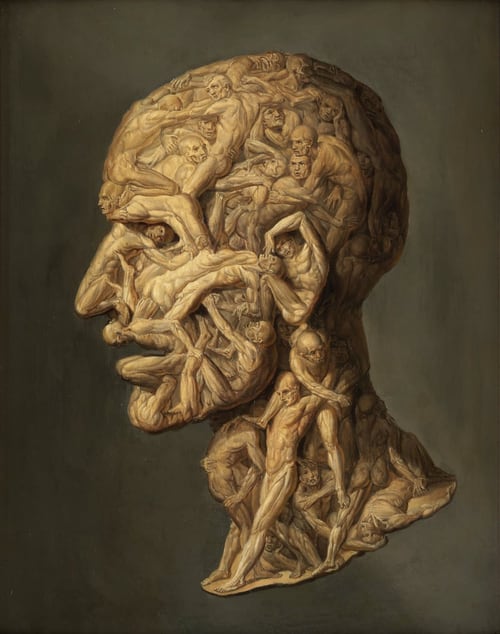
There is probably no such thing as pure brain-made pain, no pain without any nerve signals from the body about threats to tissues, what pain nerds call “pain without nociception” — an unproven and seriously flawed idea about how pain works, and yet highly influential. It’s a key premise for equally speculative treatments like pain neuroscience education (PNE), which try to teach patients to believe that a lot of chronic pain is just a false alarm coming from the brain and not the flesh. PNE is one good example of a trend in physical medicine of putting the burden of pain relief on the patient, what many patients call gaslighting.
These damning points about modern pain science and care have all been supported in new ways by three new scientific papers, quite different and yet harmonious. Here are the gists of each:
- Weisman, Quintner, and Cohen write about a “new conceptualisation of nociception” as more of a web of biological factors than just direct and specific responses to tissue insults. They also review the poor evidence for pain-without-nociception. These authors are “the usual suspects” on this subject matter, the most prolific academic skeptics working in pain research today, but they are hardly alone.
- Breedt, Tichenor, and Barlott offer a political and philosophical indictment of fashionably “holistic,” “patient-centred,” “pain-science informed” physiotherapy that isn’t as humane and liberating as intended, aligning instead with unrealistic neoliberal expectations to self-optimize, self-manage, stay productive, and keep adapting forever. These waters run deep.
- Riley, Ware, Pitre, Russell, and Flowers deliver a more conventional new systematic review of pain neuroscience education that shows not only that there is “no reliable evidence” for it, but the research itself is flawed in ways that you might cynically expect from unusually biased research. This contributes substantially to the scientific failure of pain-without-nociception.
This post explains each paper, and there are even more detailed “translations” available in the PainSci bibliography if you follow those links.
Paper #1: Pain needs nociception (to be defined a little more broadly)
Weisman A, Quintner J, Cohen M. Adieu to an aphorism: why nociception is necessary for pain. Brain. 2025 Oct:awaf387. PubMed 41091638 ❐
This new review article directly challenges the claim that pain can happen without “nociception,” or proto-pain signals: nerve impulses converted from diverse noxious stimuli, representing potential threats and insults to the organism, which may or may not lead to pain. It’s dense and technical reading. This summary is quite simplified!
Weisman et al. accept that nociception can occur without pain (lots of minor nociceptive “noise” that the brain doesn’t take seriously), but they argue forcefully that nociception is a prerequisite for pain, and the popular idea that it’s not necessary has never been convincingly demonstrated, and has caused theoretical and clinical chaos. They report no credible evidence of pain arising without nociceptive activation in some form. “Nociception is necessary,” they conclude, “but not sufficient for pain.”
To make this work, they propose an expanded view of nociception as activation of a complex integrated nociceptive apparatus — distributed across peripheral, spinal, supraspinal, and immune systems — as opposed to relatively isolated and direct peripheral noxious input from tissue insults. In other words, nociception can also get fired up by a biological situation. This patches some genuine ambiguity in the formal definition of nociception, and allows chronic/nociplastic pain to be biologically grounded — no more need to assume that they are entirely brain-made just because there’s no obvious, specific biological cause.
Tinkering with the definition of nociception is a bold move, but I think they've done it thoughtfully, and it does help to explain the absence of evidence for pain-without-nociception.
Criticism of pain-without-nociception provokes many common objections, and the paper deals with some of them, as I have in the past:
- What about phantom limb pain? (The nociception comes from the stump!)
- What about placebo and nocebo? (Reports of their “power” are greatly exaggerated/misrepresented as being direct effects on pain.)
- What about boot nail guy? (One thin anecdote, missing several relevant key details? Get outta here!)
- Does anyone even really think this? (Oh, hell yes they do! I’ll hear from them about this post. I might hear from you.)
I’ve written about all of those and quite a few others in much greater detail. I have updated and unlocked an early 2023 post that was originally for members only, now available to all. This was just too valuable to store behind the paywall forever. Merry Christmas!
Can the mind create pain? How do you know if your pain is psychosomatic? Can our minds create pain, out of nothing? Can we have pain for psychological reasons alone? Does such pure psychosomatic pain exist — pain with no injury at all, no issue in the tissue, no noxious stimuli of any kind? Can we “hallucinate” pain? Short answer: probably not, as far as I’ve been able to determine. But I do not know, and I am not done trying!
Paper #2: Shifting the burden of pain relief onto patients
Breedt E, Tichenor E, Barlott T. Diagnosing the body in physiotherapy: the passage from discipline to control. Physiother Theory Pract. 2025 Nov:1–25. PubMed 41215734 ❐
Breedt et al. supply a profound new indictment of some fashionable trends in physical therapy: maybe, they suggest, physiotherapy that is intended to be “holistic,” “patient-centred,” and “pain-science informed” is not all it’s cracked up to be, not actually humane or liberating or empowering. Maybe it even backfires! Maybe it extends physiotherapy’s reach into more intimate aspects of life — an overreach that amplifies unrealistic neoliberal expectations that we should all be keeping ourselves healthy enough to be well-behaved worker drones in the hellscape of late-stage capitalism, and a world full of frayed and broken social safety nets. The insidious ideal is that we should always be working on ourselves to cope with and adapt to fundamentally unhealthy social predicaments.
A lot of pain has its roots in the chronic health issues that arise from serious social problems and generally poor healthcare.
They argue that supposedly psychosocially-informed physical medicine is in fact just blaming pain on failed self-regulation — on being insufficiently brave, robust, and resilient. In other words, progressive physio tends to put the burden of pain relief on the patient. On behalf of patients, I would boil that down even further to just a single word: gaslighting. This adds insult to the injury of the social injustices and political machinery that predispose people to chronic pain and poor healthcare in the first place. Rather than addressing those structural harms, it may be contributing to them (unwittingly, of course).
This will all sound weirdly political to many readers, but these ideas aren’t new, and the paper has excellent company:
- McMindfulness, Ron Purser’s superb book about how meditation and mindfulness have been corrupted by The Man to serve as a well-disguised “technique for social control and self-pacification.”
- Roberts, a condemnation of the biopsychosocial (BPS) model for “lacking meaningful scientific content” and its widespread abuse.
- Cormack et al., a dense and smart review of what’s gone wrong with BPS care and how it might be fixed.

“Patient-centred” care can be twisted to focus on the patient’s own “failure” to be fire-proof in extremely hostile socioeconomic conditions. (This is the 2013 “Gunshow” webcomic by artist KC Green that became a meme that has been used to illustrate the pathos of countless life predicaments. This metaphor will appear again soon!)
Paper #3: “no reliable evidence” that PNE is effective (and there bloody well should be at this point)
Riley SP, Ware E, Pitre Z, Russell N, Flowers DW. Pain neuroscience education combined with any singular form of physical therapy intervention is not more effective than the single intervention itself: a systematic review. J Man Manip Ther. 2025 Nov:1–11. PubMed 41262073 ❐
First off, a quick refresher: pain neuroscience education (PNE) aims to reduce perception of pain by educating people about how pain works, especially chronic pain, mainly by emphasizing that it’s often an exaggerated or entirely “false alarm” based on misunderstandings about what it means. It rests on the premise that a lot of chronic pain is being driven by vicious cycles of fear and habit — which can be broken by the power of knowledge that “pain doesn’t mean damage.” PNE aims to boost pain tolerance and movement while easing nervous system hypersensitivity.
Now that is something you can test — and you certainly should before selling it. There are complications, but it’s hardly an impossible scientific question. If PNE works, then chronic pain patients who get PNE-style care should get measurably better than people who get other kinds of encouragement and coaching and attention.
But the research is apparently too difficult in practice so far!
Riley et al.’s PNE review is bleak: they conclude that trials of PNE are a bit of a mess and have given us “no reliable evidence” that PNE is effective. This puts PNE somewhere on the spectrum between absence of evidence and evidence of absence. It strongly suggests that
Lead author Sean Riley (in correspondence):
Beyond the absence of evidence, or evidence of absence, the real issue here is who holds the burden of proof, and did the holder of the burden meet that threshold? Research with unknown integrity, with effects smaller than measurement error, with variability that crosses zero, suggests that the burden has not been met, and the absence of reliable evidence precludes making any clinical practice recommendations.
In light of this damning review, all the debate about whether there is such a thing as pain without nociception constitutes “mechanism masturbation” — a lot of speculation about how something might work for pain in the absence of any good evidence that it actually does work. The PNE cart has gotten waaay ahead of the horse.
My mind has changed
I remember the first time I was infected with the idea that pain might be possible without nerve impulses flashing from body to brain. What a big and tantalizing idea! It transformed the way I thought and wrote about pain for many years. I have come to regret that. There’s some work I wish I could undo.
After watching the evidence evolve over the last decade, the scientific failure of pain-without-nociception seems clear and consequential. It’s the basis for many pain treatments that are also clearly on thin scientific ice, most notably PNE. And there’s even significant risk of harm to patients in blaming their pain on a deficit of resilience, or a surplus of anxiety and fear.
And so I never want to describe pain as “false alarm” again. Somewhat exaggerated, maybe, but not false. Pain means that something is wrong in the flesh, something driven by nociception and diagnosable in principle — even if it’s difficult or impossible in practice. Maybe the mind can turn the volume of pain up and down — modulation might be a baby we don’t want to throw out with the bathwater — but is it clinically useful? Can it be induced, taught, inspired, and to what degree? Probably not much, not if PNE doesn’t work very well. Or CBT. Or PRP. Or CFT. Or really any known way of using psychological levers to tinker with pain.
I haven’t completely given up on pain-without-nociception, but — thanks to these new papers — I am now about as close to that edge as I can get without falling off it.
“It doesn’t matter”: a common objection to even talking about the necessity of nociception
I’ve seen many variations of this opinion over the last few years:
In my experience, I don’t come across many who believe that pain doesn’t require nociception. This all seems like setting up target to just shoot it down. What problem is focusing on this solving? I don’t see what all the fuss is about.
My experience is different. Sure, this is nerdy, academic subject matter that most professionals will never even think about directly or deeply, let alone have an awareness of its implications and consequences. Despite that, it’s not as obscure a topic as it looks like, and my inboxes overflow with people passionately demonstrating their belief that “pain doesn’t require nociception” — or their outrage over its consequences.
This is, in fact, one of the biggest ideas in physical and pain medicine. It’s often not recognized as such because of the necessity of nociception is the nerdy, mechanistic framing. But it’s just the technical version and major premise (usually unstated) for a much more familiar concept: the hypothesis that pain can be powered by the mind. It is just one short, inevitable conceptual hop from “nociception isn’t necessary” to “therefore some pain must happen some other way, and the only candidate is psychology.” And lots of people believe in psychosomatic pain, and they have many related beliefs and claims about it — many of which are on display in this very comment thread, many of which the paper is about.
But if nociception is necessary for pain, most of those beliefs and claims are wrong. That is the problem to solve. That is what the fuss is about. See this review of all the specific ideas people have about how pain can allegedly happen without nociception. For something people supposedly don’t believe, they sure have a lot of ideas about it!