


Suffering with pain is “optional”?
This famous quote from Haruki Murakami contains both genuine wisdom and great potential for abuse in the context of chronic physical pain:
“Pain is inevitable. Suffering is optional.”
It’s not a useless idea, of course, but it is highly problematic for pain patients — and it does infect pain care. In this post:
- The strong harmonization between “suffering is optional” and toxic positivity.
- Many common types of pain are just too much like torture to transcend. Pain and suffering are inevitable.
- Please never risk implying that people could be suffering less with their pain if only they were somehow … wiser. Smarter. If only they could just get their shit a bit more together.
This is the third thing I’ve written about suffering lately, and they’ve now all been bundled together into a new article about pain-related suffering — follow that link if you want to read it all together.
The generous perspective on “suffering is optional”
It’s a famous quote for good reason. Obviously there is some value in the idea. It is clearly useful if “pain” is defined loosely: the pain of life! Existential anguish, grief, Weltschmerz, dukkha.
“Pain” gets used poetically a lot. We use it as a metaphor or analogy to describe other very strong, unpleasant emotions. We use it that way precisely because it is different, in a league of its own, so much more immediate and vivid and disruptive; it’s what we measure other strong emotions against, declaring that they are “pain-like” in their intensity and power to make us suffer. In my tortured youth, I was often stunned into paralyzed despair by all the awfulness in the world that I couldn’t look away from. I was rescued from that pattern partly by Victor Frankl’s book, Man’s Search for Meaning, which (long ago) gave me the mind-blowing idea that I could always choose my emotional response to life’s challenges, no matter how extreme — especially since they were obviously less extreme than Frankl’s had been (in a Nazi concentration camp).
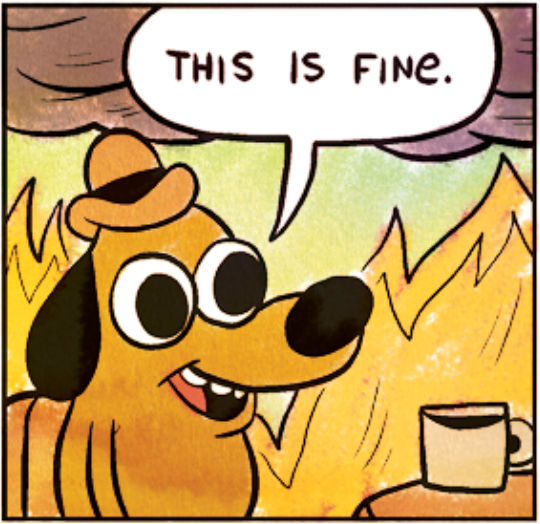
The 2013 “Gunshow” webcomic by artist KC Green that became a meme that has been used to illustrate the pathos of countless life predicaments — and it couldn’t be more apt for this “suffering is optional” thing!
And “suffering is optional” is the pithiest expression of that principle. So yes: it can be useful.
But it’s much less useful when it comes to the pain of having a sick or hurt body. And it’s so ridiculously ripe for abuse, so easily transmogrified into gaslighting, that I consider it verboten.
It is true that we can figure out how to suffer less with some kinds of pain. Many good healthcare professionals will focus on those opportunities, healthcare of the possible, helping people achieve whatever can be achieved in some of life’s most painful and intractable medical predicaments. Good stuff, truly.
But that can all be achieved without ever leaning on any interpretation of “suffering is optional.”
The link between “suffering is optional” and toxic positivity
We shouldn’t ever actually say “suffering is optional” because it so strongly implies that pain-related suffering can be nuked from orbit by sheer force of will — an idea that angers and demoralizes millions of pain patients every day. The phrase doesn’t have to imply that, but it usually does anyway, because it harmonizes so clearly and dangerously with “toxic positivity.”
Toxic positivity is the culturally pervasive and harmful belief that even serious health problems can be greatly mitigated by the power of positive thinking. It always sounds uplifting until you turn that coin over and see … ah, yes, there’s the problem: blaming continued illness on the failure to think positively! That doesn’t sound right! Because it’s not.
“Suffering is optional” and “positive thinking heals” are practically the same idea in practice for the last twenty years.
Many common types of pain are just too much like torture to transcend
Suffering and disability might be blunted and eased — and they should be wherever possible — but they will never be “optional” with conditions like fibromyalgia or trigeminal neuralgia. Other examples:
- Cluster headaches will make a mockery of almost anyone’s best efforts to not react to the pain with suffering.
- Chronic pancreatitis is a pain Goliath that will crush the patient’s David every time — there are no unlikely victories for an underdog against an opponent that huge and fierce.
- Gout is famously disabling and dehumanizing even to the most stoic patients.
- Rheumatoid arthritis can feel like being on fire from the inside out, and in the history of human psychology no one has ever found a way to be “fine” with that.
And so on and on. This is just a few highlights from the full list of the worst imaginable chronic pains (a closely related blog post from a few weeks ago, which was a digression while writing this one — a footnote that turned into a separate post).
Please never risk implying that people could suffer less with pain if only they were wiser
There are some fascinating exceptions, chronic pain patients who have found ways to suffer less than others, despite profound ongoing pain — but they are rare and mostly just prove the rule. For most people with severe chronic pain, the idea that suffering is “optional” is unrealistic at best … and fully offensive, gaslighty, and irresponsible at worst. The risk of the latter is so great that it’s best to steer clear of it completely.
Here’s a good example of a chronic pain patient being irritated by the Murakami quote:
As someone with a chronic pain disorder, while I appreciate the concept of trying to live your best life despite whatever gets thrown at you, this is hot nonsense. There is no other way to describe a decade of constant pain as anything other than suffering.
Like that person, I much prefer this adage (no clear attribution), which seems much less vulnerable to abuse:
If you’re going through hell, keep going.
That is an inspiring slogan I can work with! It captures the spirit of what I like most about occupational therapy, for instance. Good healthcare should always try to help people with pain to “keep going” with as much dignity as possible. But the suffering is not optional.
Once again, this is a fresh excerpt from a new article about pain-related suffering.