


Stretching not exactly a pillar of fitness, 20 experts agree
Twenty stretching experts pooled their expertise for an ambitious consensus paper. It’s not a “scientific review,” exactly: it formalizes expert opinion of existing reviews, which is more clinically useful, more practical and broader in scope than a scientific review (but also less rigorous on any specific point).
Warneke K, Thomas E, Blazevich AJ, et al. Practical recommendations on stretching exercise: A Delphi consensus statement of international research experts. J Sport Health Sci. 2025 Dec;14:101067. PubMed 40513717 ❐ PainSci Bibliography 49373 ❐
The clickbait headline for this would be “The Great Stretching Myth: 20 Scientists Reveal What Actually Works — and What Doesn’t.” And it doesn’t work for much.
Speaking of consensus, this paper mostly has my back on everything I’ve ever written about stretching. It’s like a summary of my own work on the topic. It was a megadose of confirmation bias — and you can enjoy that more when you know that you’ve really done your homework on a topic and your position is not just your bias!
Herding expert cats
A bunch of experts is a proverbial “herd of cats,” so how do you get them on the same page? You use a structured “Delphi” process — a formal, multi-round method for reaching expert agreement. The all met up to kick things off, and then after that it was all written opinions, iterative and anonymized (although I bet some opinions didn’t have to be signed to be recognizable). They settled on definitions for the three main types of stretching: static (holding a muscle at length), dynamic (controlled movement through range), and PNF (a combination of stretching and muscle contraction).
They were more divided on the definition of “dynamic stretching” than anything else they covered — just 80% agreement. Very on-brand for exercise science. 😏
After definitions, they reviewed the reviews on eight major stretching topics: range of motion (ROM), strength, muscle growth (hypertrophy), stiffness, injury prevention, recovery, posture, and cardiovascular health.
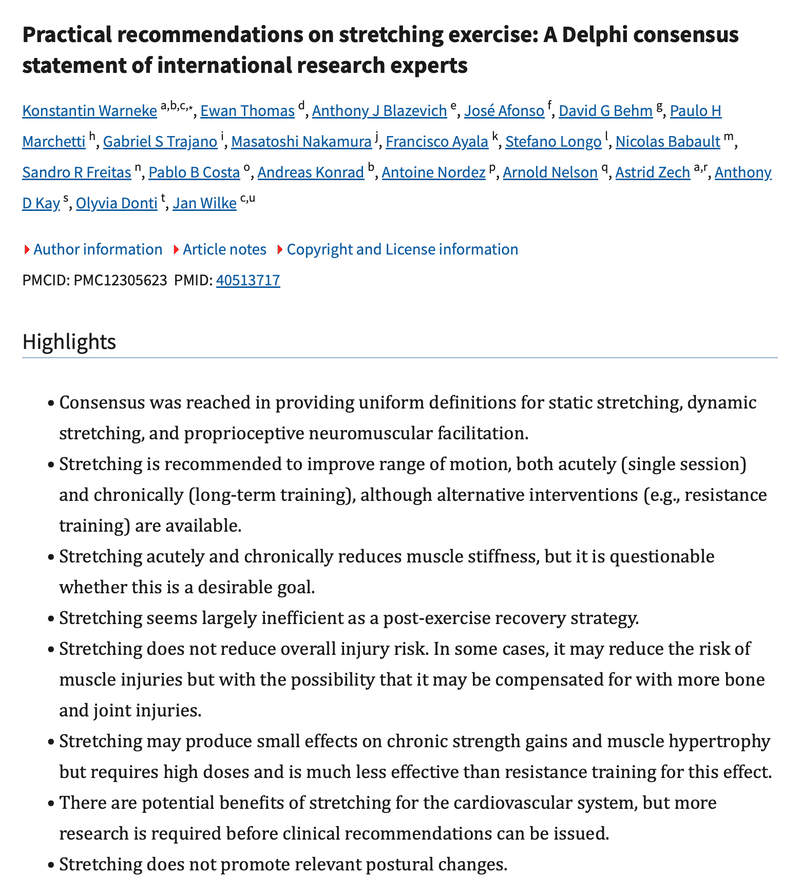
No time for my summary? Just read this! But I have added some good perspective, I hope.
The least bad news: flexibility
The clearest finding (95% panel agreement): stretching reliably improves flexibility. “It is known”: both short-term (acute) and long-term (chronic) stretching increase ROM. But curb your enthusiasm, because stretching is not the only way to unlock this achievement — other activities like resistance training or foam rolling can improve flexibility just as well, and arguably resistance training offers far better bang for your exercise buck.
And it’s also the only benefit of stretching the panel confirmed wholeheartedly. All other benefits were minimal and heavily disclaimed.
The next closest thing to good news: flexible blood vessels
Warneke et al. give us a very cautious recommendation to stretch for … cardiovascular health? There’s some evidence that stretching reduces arterial stiffness and improves cardiovascular health. But the evidence isn’t good enough yet, and this benefit (like flexibility) can likely be had better with other kinds of exercise — leaving it only as a practical option “for those unable to engage in active (therapeutical) exercise.”
Plenty of mixed and bad news
They also acknowledge that stretching might reduce the stiffness of muscles or tendons, but with important caveats: it takes a huge dosage, it’s not a strong effect, and it’s not even clearly a good thing (tendon stiffness is probably a feature, not a bug).
On strength and muscle size: a good dose of stretching (>60s) makes you temporarily weaker, acutely undermining explosive effort. Over weeks, high-volume static stretching can (weirdly) increase strength and muscle mass — but only slightly and requires a surprising time investment: do 15 minutes per muscle per day for six weeks, and you may not have time for much else, and all for what? “Slight” strength gains. The panel bluntly states stretching is not recommended as a primary strategy for building strength or muscle.
Injury prevention? Despite decades of hopeful practice and research, the thin evidence definitely does not support stretching as a general injury-prevention tool. Some data suggest static stretching might reduce muscle injuries, but maybe at the cost of more bone/joint injuries (plausible, but based only on scraps of evidence so far).
Soreness? Does it take the edge off? The panel agreed 100% on this one: no!
The other recommendation they were unanimous on: don’t bother stretching to improve posture. Not that posture generally needs much improving. But even if it did, stretch wouldn’t help.
“More study needed,” of course — but it’s sure not looking good for stretching
Some limitations: the panel was overwhelmingly male, they focused on healthy populations, and they relied on existing systematic reviews — which rest on a foundation of trials that leaves much to be desired. As the authors note, “scientific research is an ever-evolving process,” and “a number of stretching applications have barely been explored in the literature.”
Stretching is nowhere close to being a pillar of fitness like so many people assume. It has only a couple known or half-known benefits, and even those aren't clean wins, because other kinds of exercise do the same and more. Stretching remains something to do almost entirely because it feels good; most common goals that people have in mind for it are faith-based at best, or actually contradicted by the science we have so far.