


Pain and/or suffering: related but distinct
Whoever is spared personal pain must feel himself called to help in diminishing the pain of others. We must all carry our share of the misery which lies upon the world.
Albert Schweitzer
Anything nice or uplifting will “help” chronic pain — like good music, or puppy boops, or seeing a Nazi get punched. But that’s about easing suffering, not pain itself. At best, things like music therapy might produce some modest modulation of pain intensity. While that is a good thing in itself, it’s also not strong medicine for the actual pain that’s driving it.
And yet think about how many “treatments” for pain are essentially just … pleasant.
I took a short ride on this train of thought recently and shared it on social media. The above is a more carefully phrased version, and now I’ll take that train to several more stops, addressing some key points raised by commenters.
Isn’t reducing suffering a good thing?
Yes, of course. People should be helped with their suffering and disability as much as possible, in every way possible.
I am on the record extolling the virtues of inherently pleasant treatments — like some kinds of massage therapy — arguing that the pleasantness is the point. In the absence of clear medical benefits, massage is at least a sensory treat that can improve mood and reduce anxiety, inspire, and give us a bloody break or distraction from whatever pain we have. That has real value.
As a chronic pain patient myself, I have enjoyed many an ephemeral pleasure or comfort that “helped” my pain by helping me live with it. But I’ve also never mistaken it for actually treating the pain that was causing the suffering in the first place.
The original point of my basic post was just that relieving suffering is not the same thing as relieving pain.
Unless they are the same? Which is strongly implied by the formal definition of pain?!
Pain is formally defined as an “unpleasant sensory and emotional experience associated with actual or potential tissue damage, or described in terms of such damage.” The definition of pain includes our emotional experience of it.
Both pain and suffering are subjective experiences that can’t be measured. There is no pain-o-meter or misery-o-meter. A person with moderate pain and high psychological distress is mostly indistinguishable from someone who is calmer about much more intense pain.
And what is indistinguishable in practice is practically identical.
Pain and suffering are still different things, I pinkie swear
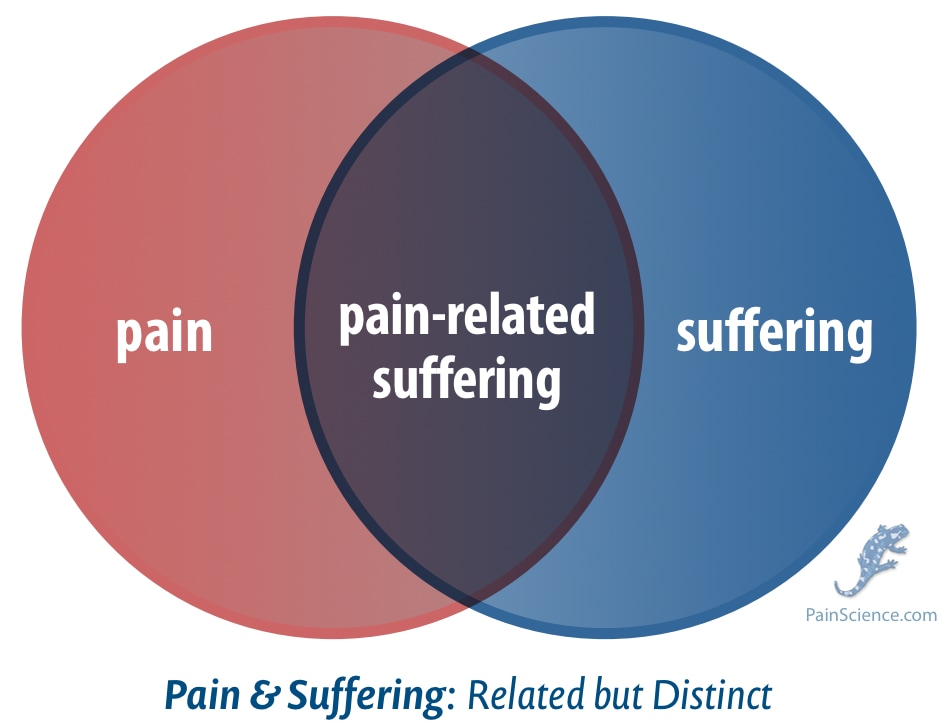
Identical in practice is not identical in theory. There is no formal definition of pain-related suffering, somewhat famously among pain nerds, but here’s my crack at an informal definition, cribbed from Stilwell et al (co-authored by salamander friend Keith Meldrum of A Path Forward):
Pain-related suffering is a subjective experience characterized by negative emotions that are related to pain but distinct from it, and which can disrupt even a “minimal” sense of self.
The lines between pain and suffering get blurry because they affect each other and produce similar behaviours, not because they are literally the same phenomenon. They may be hard to tease apart from the outside, but they are still neurophysiologically distinct — much like anxiety and depression, but no one thinks those are identical. Or pain and injury, or yin and yang, or burritos and tacos. This is what Venn diagrams are for!
So what? Why does it matter that they’re different?
The distinction matters because pain and suffering can be conflated in ways that are quite harmful to patients.
Relatively minor comforts and pleasures are often misrepresented and oversold as a form of pain treatment, even prescribed and emphasized in lieu of a dedicated pursuit of a diagnosis for pain that actually is treatable. Unfortunately, I think this happens much more than it should.
A great many kinds of chronic pain are extremely difficult to treat, if not impossible, but not all are. For instance, when women report symptoms, they are often not taken seriously — and pathology that could be treated is never even diagnosed in the first place. And that tragedy is exacerbated when those
Consider the example of migraine, which is often under-diagnosed (see Loder et al.) and misattributed in women to “stress” or “hormonal” issues. But many migraines are highly treatable. Horrendous!
There’s no way to know how often this mistake is made, or how badly. But I believe this kind of healthcare malfunction happens because I’ve personally experienced it, and because I’ve heard many such stories from both my own clients (back in the day) and also from my readers (over the last 15 years). It’s also quite plausible, because “that figures,” given human nature. It is often associated with not taking pain seriously, a patronizing attitude that implies that the pain is “no big deal,” and therefore a little comfort and reassurance ought to do the trivial trick. Even in more earnest pain treatment contexts — like trying to treat chronic pain patients with cognitive behavioural therapy — I see the worrisome and self-serving assumption that it works because suffering is actually driving the pain, rather than the other way around, and therefore treating the suffering is an indirect way to treat pain. That’s an uncertain hypothesis at best, or dangerous snake oil at worst.
Thinking about pain and suffering as distinct ideas helps us navigate these troubled waters.