


What is Pain-Related Suffering? Conceptual Critiques, Key Attributes, and Outstanding Questions
Three pages on PainSci cite Stilwell 2022: 1. Manual Therapy: What is it, and does it work? 2. Pain and/or suffering: related but distinct 3. Suffering, Disability & Pain
PainSci notes on Stilwell 2022:
This article argues that “pain-related suffering” remains an underdeveloped but important idea in pain science. Despite decades of emphasis on suffering in theoretical models, it has never been clearly defined by the International Association for the Study of Pain.
This paper did not technically attempt a “definition,” but rather a preliminary step towards an “operationalization” — a bridge between theory and practice, a guide to how we might study and recognize pain-related suffering. Here’s an informal, candidate definition based on this work could go like this:
Pain-related suffering is a subjective experience characterized by negative emotions that are related to pain but distinct from it, and which can disrupt even a “minimal” sense of self.
Stilwell et al. built on Eric Cassell’s influential writings, and critiqued them. Cassell described suffering as a private experience of distress caused by a perceived threat to one’s integrity as a person — but his definitions were inconsistent and probably too dependent on self-reflection. If being able to think about yourself in detail (self-reflection and awareness of past and future) is necessary for suffering, that would exclude infants, animals, or people with impaired cognition.
The paper cites diverse philosophical, psychological, and clinical literature to identify four essential attributes of suffering:
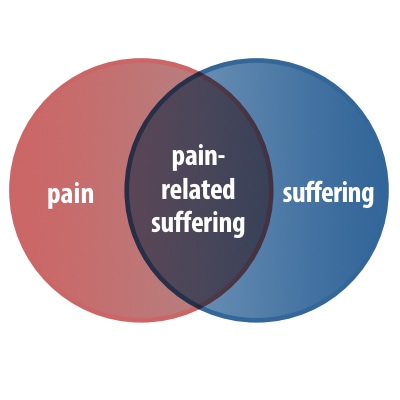
- Pain and suffering are inter-related yet distinct: one can hurt without suffering, or suffer without pain. Suffering is not reducible to nociception or sensory intensity; it arises when pain becomes personally meaningful as a threat to the self.
- Suffering is fundamentally subjective. Like pain, it cannot be directly observed or measured by external markers; it can only be known through narrative and self-report.
- Suffering is characterized by a negative affective valence — an overarching emotional tone of distress, fear, anger, and/or despair. This clarification avoids Cassell’s circular use of the term “distress” and anchors suffering within affective terminology.
- Disruption to one’s sense of self is a major aspect of suffering. Persistent pain can fracture identity: patients report losing their former roles and values, being forcefully changed.
The authors also explain that evidence from phenomenology and pain narratives suggests that suffering can obliterate reflection rather than requiring it. They suggest accounting for this by citing Shaun Gallagher’s “minimal self,” an alternative to the more conventional narrative self, a felt ownership of experience that exists without a “story” about who you are, where you’ve been, or where you’re going. In other words, pain can cause suffering before you have a chance think about what it means for your hopes and dreams for the future. But then of course it can also mess with that!
The authors call for qualitative research to distinguish reflective and pre-reflective suffering, to guide better clinical recognition and relief of suffering in all creatures capable of it.
original abstract †Abstracts here may not perfectly match originals, for a variety of technical and practical reasons. Some abstacts are truncated for my purposes here, if they are particularly long-winded and unhelpful. I occasionally add clarifying notes. And I make some minor corrections.
Suffering holds a central place within pain research, theory, and practice. However, the construct of pain-related suffering has yet to be operationalized by the International Association for the Study of Pain and is largely underdeveloped. Eric Cassell’s seminal work on suffering serves as a conceptual anchor for the limited pain research that specifically addresses this construct. Yet, important critiques of Cassell’s work have not been integrated within the pain literature. This Focus Article aims to take a preliminary step towards an updated operationalization of pain-related suffering by 1) presenting key attributes of pain-related suffering derived from a synthesis of the literature and 2) highlighting key challenges associated with Cassell’s conceptualization of suffering. We present 4 key attributes: 1) pain and suffering are inter-related, but distinct experiences, 2) suffering is a subjective experience, 3) the experience of suffering is characterized by a negative affective valence, and 4) disruption to one’s sense of self is an integral part of suffering. A key outstanding challenge is that suffering is commonly viewed as a self-reflective and future-oriented process, which fails to validate many forms of suffering and marginalizes certain populations. Future research addressing different modes of suffering - with and without self-reflection - are discussed.
PERSPECTIVE: This article offers a preliminary step toward operationalizing the construct of pain-related suffering and proposes priorities for future research. A robust operationalization of this construct is essential to developing clinical strategies that aim to better recognize and alleviate suffering among people living with pain.

This page is part of the PainScience BIBLIOGRAPHY, which contains plain language summaries of thousands of scientific papers & others sources. It’s like a highly specialized blog. A few highlights:
- Long-Term Effects of Repeated Injections of Local Anesthetic With or Without Corticosteroid for Lumbar Spinal Stenosis: A Randomized Trial. Friedly 2017 Arch Phys Med Rehabil.
- Cannabis-based medicines for chronic neuropathic pain in adults. Ateş 2026 Cochrane Database Syst Rev.
- Effect of exercise on depression and anxiety symptoms: systematic umbrella review with meta-meta-analysis. Munro 2026 Br J Sports Med.
- Optimizing elastic band resistance training for Metabolic Syndrome components in older adults: A systematic review, meta-analysis, and meta-regression of randomized controlled trials. Saez-Berlanga 2026 Arch Phys Med Rehabil.
- Biomechanical insights into Achilles tendinopathy risk and protection in runners: a large prospective study 4HAIE. Jandacka 2026 Br J Sports Med.