


City noise pollution may aggravate pain (and nature sounds don’t help)
This post is about an actually good study of nature sounds for fibromyalgia — seriously! It is possible. There aren’t even any major asterisks on that. * Gungormus and Pérez-Mármol did a fine job.
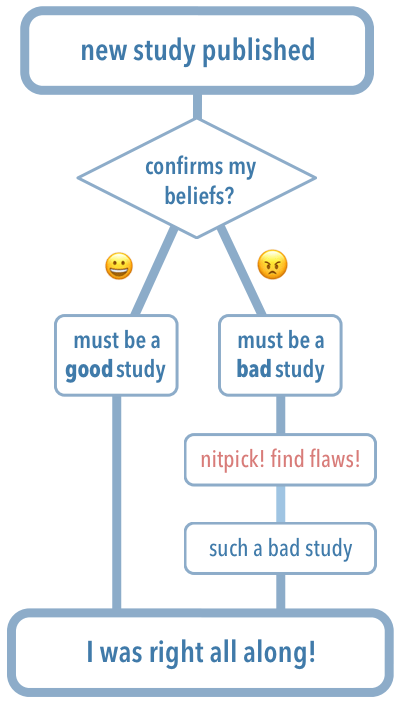
“Nature sounds are good for pain” is one of those ideas that many people just want to believe, and to hell with the evidence. If a study seems to back it, no matter how superficially, they’ll claim the win; if it doesn’t, “must be a bad study.” show flowchart
But this actually good study does not support prescriptions of birdsong and gurgling fountains for fibromyalgia (unexplained chronic widespread pain). In fact, it shows natural sounds were not only no better than silence, but actually trivially worse. And so the useful lesson isn’t that “nature helps,” but that noise-cancelling headphones playing nothing should work just as well as any nature-sounds app, because the active ingredient is masking irritating noise, not nature. And that flips it politically and philosophically too: it highlights the burden of noise pollution as a public-health problem, rather than more clutter on your wellness to-do list.
* There is one minor asterisk on the study’s goodness. The authors do not particularly push the nature-cure story, and that’s incredibly refreshing … but they don’t discourage it either. Their abstract fully ignores the natural-vs-placebo null, and their conclusions are vaguely optimistic about “the potential for environmental interventions to improve the lives of individuals living with chronic pain.” That spin is mild, as these things go. But it does make it awfully easy for others to incorrectly cite this paper to support nature-cure claims.

The bright pink leaves of a “red” maple in VanDusen Garden, a botanical garden I am lucky to be able to visit regularly — partly for how it sounds, whether that’s “nature sounds” or just “less noise polluted” than the surrounding city.
Urban sounds hurt
We shouldn’t emphasize “nature sounds were trivially worse than silence,” because that is probably just noise (ha ha), not a signal. But Team Pseudoscience would call that noise a signal if it favoured their preferred outcome! They would call it “possibly marginally significant” or hundreds of other examples of trying to polish a turd. If we use the pseudoscience playbook to exaggerate the debunking instead, we might say that nature sounds were trending to approach harm.
At any rate, nature sounds certainly weren’t better than silence. But guess what is a modest but measurable problem?
Urban sounds! Harleys farting in the distance, bottle scavengers rooting through bins, the thump thump thump of car stereos that could be weaponized.
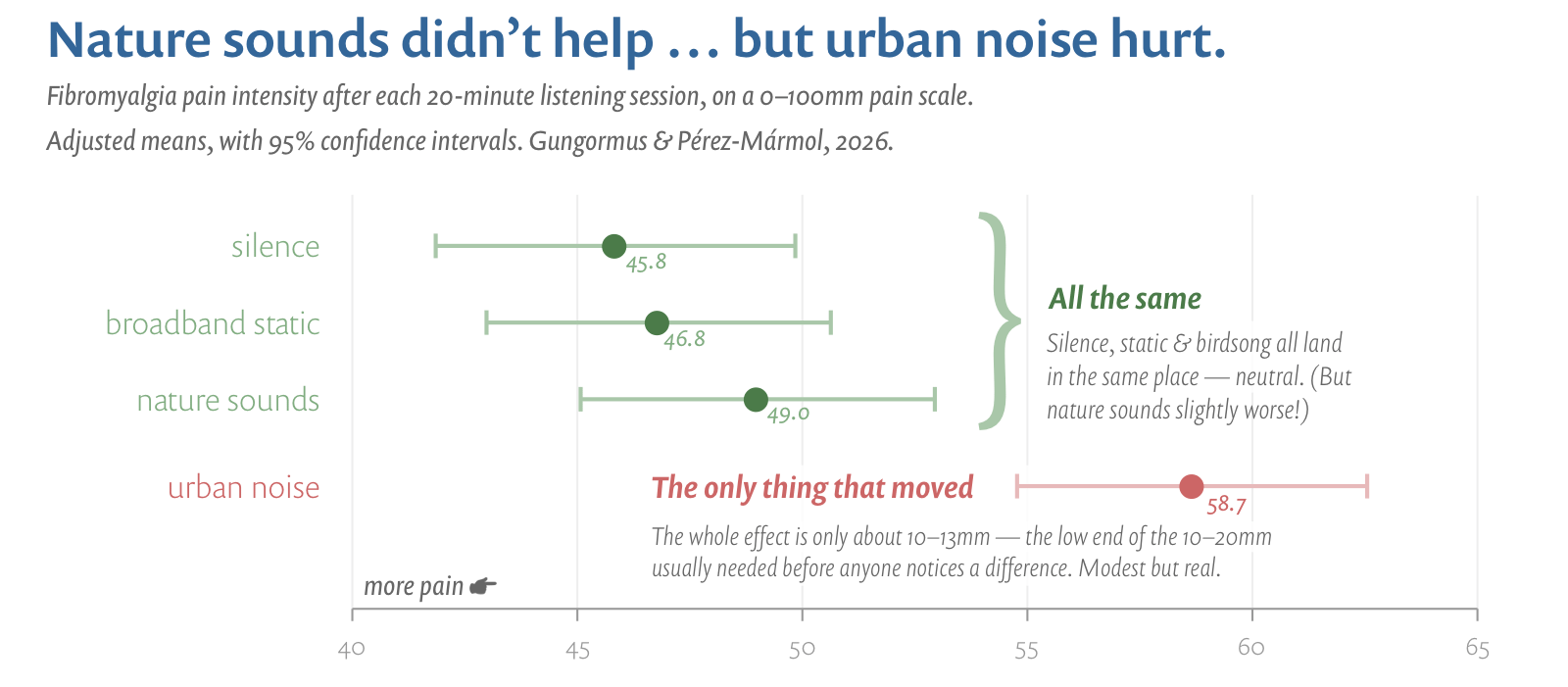
Gungormus and Pérez-Mármol exposed 88 people with fibromyalgia to four 20-minute listening sessions each — natural sounds, urban noise, broadband sound, and silence, one per week. The “medium effects for pain intensity” they report are about urban noise making pain worse, not natural sounds making it better.
And we should believe it, because this experiment ticks all the good-design boxes: everyone tried every condition in random order, nobody involved could tell who was getting what, the whole plan was locked in (registered) before a single session started, and enough people stuck around to trust a negative result. The correctly read finding may not support the nature-cure narratives that people are likely to impose on it, but it is very credible: urban noise mildly worsens fibromyalgia symptoms in the short term.
And what does that mean?
Urban noise hurts but nature sounds don’t help: what’s even the difference?
Because, if you’re listening to nature, you’re probably not listening to sirens and garbage trucks. They seem like two sides of the same coin.
There is a meaningful difference though, and it’s all about where neutral is. In this experiment, the responses to silence, nature, and broadband all clustered together (~46–49mm pain intensity), while urban was the outlier at ~59mm — the only deviation from that shared floor. Not a huge deviation: the smallest change anyone would notice on a scale like this is roughly 10–20mm, so that ~10–13mm noise bump is right on the edge of clinical relevance, not just statistical. Small but real, not nothing. “Nature helps” is just arithmetically unavailable — it is the baseline, along with silence and broadband. The only movement in the whole experiment is urban going towards the bad place.
The practical difference is a testable prediction, and it’s the real payoff. If the true mechanism is “urban hurts,” then the active ingredient is removal of an aggravator, and anything that removes it should work equally well — silence, earplugs, noise-cancelling headphones playing nothing, white noise. You don’t need nature; you need not-urban.
And that’s what they showed: broadband and silence matched nature. If it was “nature helps” — if birdsong were an analgesic — it should have beaten silence and earplugs. But it didn’t, and so noise-cancelling headphones playing nothing should help a fibromyalgia patient as much as playing a nature-sounds app (probably for $10/month). The evidence-informed read is that masking is the active ingredient.
That’s not a philosophical nicety, that’s buying advice. Nature is demoted from expensive, privileged medicine to just … not-poison.
Fixing noise pollution might be more important than selling people nature-sounds apps
And the people bowed and prayed / To the neon god they made
“Nature heals” is the strong claim behind Attention Restoration Theory and the whole forest-bathing/biophilia literature: a forest glade actively restores you to better than baseline. Nature may heal, but this study quietly (ha ha) pushes back against one key part of the claim: the sound of nature was merely benign, not curative, no better than the sound of silence. An analgesic suppresses pain; de-noxious-ing your environment stops it from getting worse. Same endpoint, different biology — and the study’s own mechanistic story backs the second reading: urban noise as an unpredictable, salience-grabbing, amygdala-engaging low-level threat signal, which might be amplified in some nervous systems.
Nature isn’t soothing the fibromyalgic brain; urban noise is provoking it, and nature just … doesn’t.
The nature-cure perspective also isn’t as wholesome as it looks. Consider:
- Urban noise hurts is a public-health and environmental-justice claim. It implicates noise pollution as a modifiable, unequally distributed harm, and points at structural fixes: zoning, noise ordinances, who has to live next to the freeway.
- Nature sounds help is a wellness claim. It implicates you and your self-care habits. Even if it works, it’s shifting the burden of responsibility away from systemic culprits and onto your shoulders. And your pocket book, because access to nature has a price tag.
The wellness framing of this study is more marketable, which is why it’ll get citations and headlines.
But the environment framing is about a harder, nastier problem (that will probably be ignored). Ron Purser argues, in his superb book, McMindfulness, that wellness has been corrupted by The Man to serve as a well-disguised “technique for social control and self-pacification,” distracting us from socioeconomic problems, like noise pollution. Breedt et al make the same point in a physical medicine context:
“We contend that ‘holistic’ movements in physiotherapy, despite their progressive appearance, serve to control societies and perpetuate state and corporate power.”

Practical advice, and the motorcycle I could feel but not hear
The environmental angle is not all about social issues and politics: it’s also science news you can use. You can use it to avoid pointlessly pursuing nature sounds for their medicinal value, and to put the focus where it more likely belongs: avoiding, minimizing, and literally cancelling noise pollution.
As a fibromyalgia patient myself, I have been playing both sides of this equation for years, seeking out nature in the hopes that it will do me some good, and also going to great lengths to minimize noise pollution in my life. Based on this new evidence, I’ll now be shifting the emphasis to the latter. Not that I don’t still have other great reasons to seek out nature, of course, but it’s good to know that blunting noise pollution is probably the “active ingredient” I should care about. Good sound-cancelling headphones aren’t exactly cheap, but the technology has come a long way, and they unambiguously mute a lot of noise that I now know probably is a problem I want to solve — so I can feel better about the investment.
I had a strange sound-cancelling scare recently. I was walking down a busy street when I felt an intense tremor in my chest. Holy shit! I thought. Heart trouble?! Something weirder? But a moment later I realized that it was a motorcycle that I could barely hear, because my noise-busting ear buds are that good now — but the sound waves were pummelling me hard enough to feel like a symptom, without the context of hearing them!
It’s not just noise pollution — it’s vibration pollution.