


Please! Stop saying trigger points do not “exist” (plus a needling study)
Today’s post is my first about “trigger points” in quite a while. It’s got two parts, loosely related:
Part 1: A little rant about the need to acknowledge the clinical phenomenon of sensitive, aching spots: people have them! Just because there’s controversy about their nature doesn’t mean they don’t “exist.” My rant is a re-worded re-run from about four years ago, so I added some new content…
Part 2: A report on a new study of treating trigger points with acupuncture needles that claims to show that it works much like tenderizing meat. They also failed to find any “contraction knots,” but did find other signs of unhealthy tissue.
Part 1: Please! Stop saying trigger points do not “exist”!
I’d like to ask all my fellow skeptics to please stop saying (or implying) that the sore, aching spots we call trigger points don’t “exist.” This has become common in recent years, as the controversy about their nature has gotten polarized and dumbed down into the same tired old tribal talking points. Instead of denying their “existence,” try this:
“The clinical phenomenon of the sore spots popularly known as ‘trigger points’ or ‘muscle knots’ obviously does exist, but we still don’t know what they are, how they work, or how to treat them reliably.”
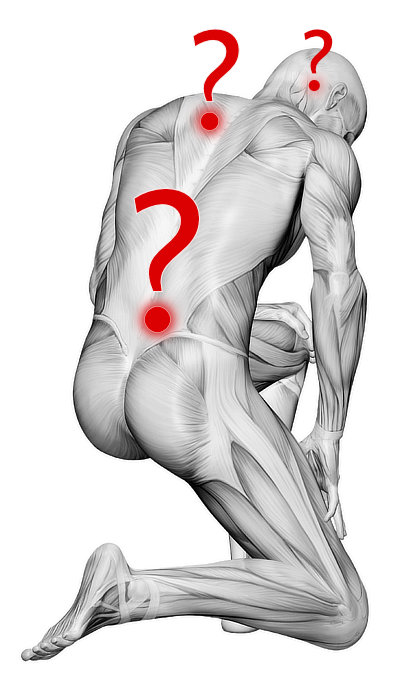
The clinical phenomenon exists.
The explanation is what’s still missing in action.
Please also consider that some people, perhaps even many people, have suffered from more and nastier “sore spots” than you can personally relate to. They can be savage. When you deny that they “exist,” or even just imply it, you are not helping the people who live with them. They just add it to their mental list of examples of professionals who patronizingly ignore, reject, and underestimate their experience of pain.
By all means, criticize the sloppy science. Definitely do dismiss the dogma, do fight the hype!
Absolutely roll your eyes with me at the well-intentioned but overconfident and simplistic claims made by trigger point therapists everywhere, every day.
But avoid giving people the impression that what they are suffering from isn’t actually a thing! The debate about their nature is a legitimate controversy about a genuine medical mystery — rather than an argument about nothing at all. Trigger point therapy has many problems, but it has never been rank quackery. It’s not in the same league as homeopathy, magnet cures, faith healing, or chiropractic subluxation theory. Much like fibromyalgia, it’s a medical puzzle with a lot of bad ideas and overconfident treatments swirling around it.
For vastly more information on this topic — still the biggest subcategory on PainScience.com — see the index of all PainScience.com content about trigger points.
Whatever the 🤬 they are.
Part 2: Study says dry needling trigger points is like tenderizing meat
One of the strangest ideas for treating the sore-spots-known-as-knots is to lance them with acupuncture needles, known as “dry needling.” It’s not acupuncture per se, but it is a cousin. I have a large chapter about dry needling in my trigger points book.
And here is some new science news about one of the last papers I saved in 2025.
Cao W, Yin L, Sun H, et al. Ultrasound features of myofascial trigger points: a multimodal study integrating preliminary histological findings from the upper trapezius. Sci Rep. 2025 Jul;15(1):20510. PubMed 40593027 ❐ PainSci Bibliography 49386 ❐
The paper is in Scientific Reports, a pay-to-play open-access mega journal run by Nature. (You pay after peer-review and acceptance, but you pay — falling far short of the prestige of a publication in the journal Nature itself.)
Cao et al. studied about fifty people with cranky shoulder muscles, testing the effect of needling on TrPs in several ways, concluding that it reduces their “thickness and stiffness” … like tenderizing meat. It supports the idea that these “points” are more about composite tissue stiffness in a small area rather than discrete pathological entities.
Their needling technique was: “ten rapid insertions/withdrawals were performed per site within two seconds.
Stab stab stab stab stab stab stab stab stab stab!
They measured the effect of all that stabbing with ultrasound, shear wave elastography, and Doppler blood-flow metrics. How thick and stiff were those painful traps muscles? How much blood was moving through them? How quickly and easily did it flow? And, of course, how painful were those poor shoulders before and after being stabbed a bunch? They only checked pain one hour after, unfortunately — there were no other follow-up checks, not even three hours later, let alone the next day or week.
They also did tissue biopsies in five patients, claiming to see tissue “remodelling” where the muscle was most sensitive: fatty patches, overgrown fascia (think “internal scar”), capillaries dancing to the tune of inflammation, and muscle fibres that looked a bit off in a few ways.
And here’s a scandal: they did not find contraction “knots,” which spits in the face of the popular idea that trigger points are “tiny cramps.” They found sick-looking muscle that was “hardened and thickened,” but not clenched:
“These findings suggest a revised pathophysiological model characterized by structural remodeling (e.g., extracellular matrix reorganization, collagen deposition) and inflammatory infiltration, which collectively increase tissue stiffness.”
They also reported that traps with TrPs on only one side were thicker and stiffer than the healthy side, and improved somewhat after needling. Blood flow also improved by two out of three metrics. And patients reported modest pain relief, falling from 8/10 to 5/10.
What do the authors think the needling was doing to the muscle? It was “mechanically altering” the TrPs and increasing circulation (“enhances local perfusion”).
Yep, perforating a muscle like a lawn aerator probably does “mechanically alter” it. 😜
How seriously should we take this new evidence?
If we trust the results, they are interesting, and the pushback against contraction knots is especially notable. It could be a meaningful addition to the scientific exploration of and debate about the nature of trigger points.
But the authors didn’t report enough for much trust. They gave no exact p-values, which is a bit fishy. Researchers generally like to report strong p-values if they have them, but these ones only declared p < .05, below the threshold for statistical significance… but how far below? They don’t say. Combined with other flaws, this is not robust evidence.
This is a technically impressive paper in some ways, but skeptics would call it a fine example of “mechanism masturbation” — of trying to figure out how something works (mechanistic investigation) without compelling evidence that it does work (clinical outcomes). And skeptics would have a point!
Also, some of the most sensational findings were based on just a handful of biopsies.
This experiment barely tested the effect on pain. It only makes sense as evidence of how needling works if it works. And it may not work (see Stieven et al for a good quality negative trial).
If it does work at all, this evidence suggests that it’s not exactly a precision tool, as it has often been marketed. Those fine needles may be blunt instruments; maybe needling is just a mechanical and vascular disruptor. If so, only clear evidence of efficacy would justify their clinical use — evidence we do not have.