


Study: Softer, quicker running improves patellofemoral pain
A small but good test of two gait retraining programs produced truly fine results for patellofemoral pain, both from running softer or dialing up cadence. And for a dorky bonus prize? These benefits came without a flicker of change in kinematics — which tickles my bias. News that I can feel good and smug about is not exactly the usual fare around here. I’ve got chills!
| title | Effects of two gait retraining programs on pain, function, and lower limb kinematics in runners with patellofemoral pain: A randomized controlled trial |
|---|---|
| journal | PLoS ONE |
| Volume 19, Number 1, 2024, e0295645 | |
| authors | José Roberto de Souza Júnior, Pedro Henrique Reis Rabelo, Thiago Vilela Lemos, Jean-Francois Esculier, Glauber Marques Paraizo Barbosa, and João Paulo Chieregato Matheus |
| links | publisher • PubMed • PainSci bibliography |
Brazilian researchers de Souza Júnior et al. recruited thirty runners and divvied them up into a three groups — so not huge — one focusing on easing impact, the other on a quicker cadence, while the third served as a control group. The runners did eight gait-retraining runs over two weeks, ramping up from 15 to 30 minutes, and they were evaluated for pain, function, and the details of their lower limb movement right before, right after, and then again after another six months of running.
Impact was eased with forefoot running and — this is cool — by working with a real-time display of how hard they were hitting the treadmill, from an accelerometer on the shin. It’s a lot easier to run softer when you can see the literal impact of every step.
The cadence group wasn’t quite as cool, but they still got a gadget: a metronome! They used that to increase their cadence by about 10%. Running cadence and speed are related, but they’re not the same thing. Cadence is your rhythm, how fast you put your feet down, like the beats per minute in a song — hence the metronome. (How fast you go depends on how big those steps are. You could have a high cadence with short strides and not be moving very fast, or a lower cadence with longer strides and be cruising along pretty quickly. So changing one doesn't exactly mean changing the other, but they do affect each other quite a bit, and most runners naturally increase both at the same time in the short term — e.g. a sprint naturally needs both, and long haul running tends to reduce both. The highest cadences require shorter steps, because a longer step just takes longer, and therefore also less hinging of the knee … which is probably why this pattern was helpful).
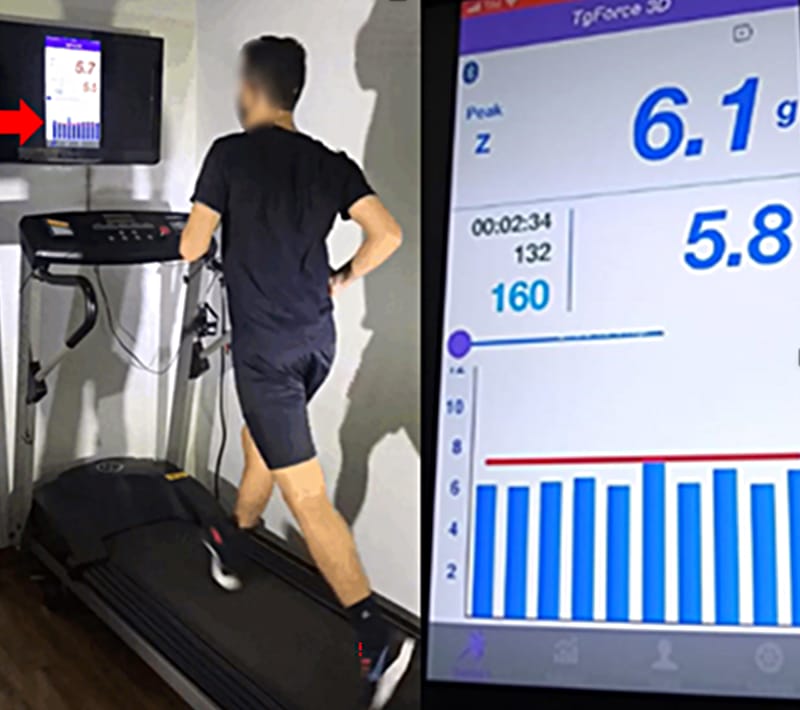
“How hard are you hitting yourself?” Runners were shown exactly how hard they were hitting themselves with the ground with a display powered by a shin-mounted accelerometer. By de Souza Júnior et al., CC BY 4.0 DEED.
Less pain without kinematics changes
Pain and knee function improved more in both kinds of gait-tinkerers than the control-group runners — but, notably, without any change to how the lower limb was moving. This flies directly in the face of the almost unanimous assumption in this business that changes in pain and function are the result of improvements in biomechanics. But that’s not what we see here. What we see instead is real change in pain and function … without the slightest signal in the kinematics. The authors write:
“two-weeks of using a strategy that does not address lower limbs kinematics directly may not be sufficient to modify these variables in individuals with patellofemoral pain.”
Mayhaps not. And maybe those variables don’t really matter at all. 🤯 And the authors do acknowledge this:
The reductions in running pain occurred regardless of differences in lower limb kinematics. Increasing step rate, adopting a forefoot striking and running softer produced reductions in running-related knee pain and peak PFJ force concurrently. Therefore, differences in running pain may be attributed to reductions in patellofemoral joint forces rather than changes in kinematic behavior.
They might just be onto something there! (I’m being a bit snarky: the research has been pointing this way hard for many years. So much so that it’s kinda weird that we're still even bothering to look at kinematics.)
Decent effect size? Check!
But just how “real” were those pain and function changes? The changes were happy changes, but… how happy? Normally I would expect to see underwhelming results, and probably overstated based on “statistical significance.” But no!
Júnior et al report an equally “large” reduction in running pain with both groups, while function improvements were “moderate.” With a larger sample size, it would be kind of a big deal. As it is, it’s just legitimately promising.
There is one off-key note
More in line with my cynical expectations, pain when not running also improved, but way less — a statistically insignificant “small” change. Less running pain is great, but people want less pain at other times too! They’d also like to be able to sit at a desk without their knees whining at them all day.
But usually all we get from a study like that is just that small and underwhelming result, almost invariably spun as “promising.” This time, it’s overshadowed by the genuine good news of a medium to strong effects on running pain and function. Good news you can use.
And hey, maybe with more softening and quickening, the general pain would start to come down too. Give it a try and let me know.