


A new PainSci article about compensatory injuries
I’ve just banged out a “new” article about implausibly complex compensatory injuries — like blaming a new shoulder pain on a ten-year-old toe stub, which is satirical only in the sense that the dumbest examples are rare.
This article was in the pipeline for ages. I did a small blog post back in 2023, answering the FAQ: “Can compensation for an old injury cause a new pain?” Yes, but mostly just the boringly obvious, short-term, and relatively minor examples. The profound “everything’s connected” ones are always a reach.
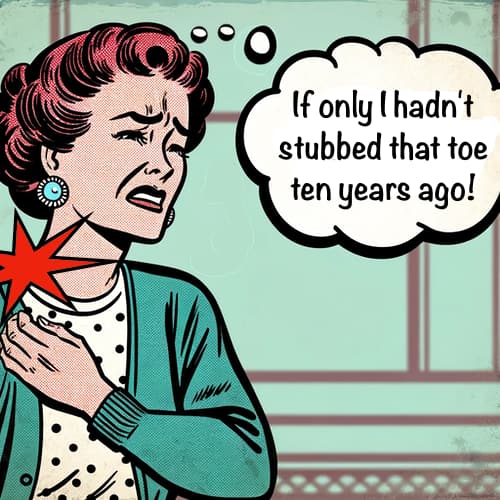
Compensatory injury ideas really do get quite silly.
Then I did a bigger, paywalled version for MSK Mag in early 2024: “The Phantom Of Complex Compensatory Injuries: Injuries causing injuries... causing injuries?”
And now there’s an upgraded free new article on PainScience.com that anyone can read, plus an audio version for members:
Here’s a summary of the topic:
Compensatory injury is the notion that an old injury can lead to new ones by forcing the body to adapt awkwardly. Straightforward versions of this are real enough: limping from an ankle sprain might irritate the back, or a hip problem may stress a knee. But such complications are mostly short-term, clinically unremarkable, and overshadowed by the primary injury.
Far more popular — and problematic — are the much more speculative “complex” compensatory injuries, like blaming a new shoulder pain on a decades-old stubbed toe. These are the “it’s all connected” stories that connect dots across chasms of time and anatomy, sometimes to the point of absurdity. They are mostly implausible and unsupported by the evidence, if not downright at odds with it. Research does clearly show that there are very few examples of even “obvious” biomechanical risk factors that reliably predict injuries, let alone complex chains of causality that a chiropractor can infer from a handful of clues.
While there may be some murky truth in the middle, the evidence does not support subtle links between old injuries and new pain. The clinical emphasis on compensation is largely self-serving, making professionals seem diagnostically sophisticated and more valuable to their clients. Injuries can certainly have complications, but blaming them for significant and seemingly unrelated new episodes of injury or pain is almost always misguided — and usually part of a sales pitch.
Some “making of” notes
This is the first new permanent article for the PainSci library in quite some time now. I used to churn them out steadily, but I’ve slowed down … because my standards just keep going up. For instance, audio versions are now standard for new articles, and that adds a lot of work.
And publication is never the end of the project: I always have to integrate the topic into PainScience.com, and that just keeps getting harder because there’s ever more “related content.” Most of my ten books and several other articles that could (and should!) now include a new chapter or section or at least a sidebar about compensatory injuries, supported by a link to the new article. That’s a long tail of post-publication effort to make it a proper member of the salamander’s family.
But I think I’ll take a breather from the topic before tackling that. 😜
Publishing has been sluggish lately. My wife and I went on a late summer trip, our first stay at Yellow Point Lodge, a fascinating, famous, and quirky camp/resort on Vancouver Island. Slogan: “Eat. Read. Sleep.” Here’s a review and photos.