


Freezing shoulders enjoy steroids, PRP not so much
A new trial from Taiwan with a respectable design and a believable result has compared platelet-rich plasma (PRP), corticosteroids (CS), and a saline placebo for shoulders in the agonizing freezing stage of frozen shoulder.
Steroids won handily, and that’s worth knowing, but I see this study as more of a bad news story for PRP than good news for steroids. Fashionable, fancy PRP couldn’t even outperform saline!
PRP is the injection of your processed blood, a concentrated mixture dominated by platelets, a blood ingredient that releases more growth factors, making it allegedly anti-inflammatory and/or “regenerative.”
CS, of course, is a powerful anti-inflammatory drug, often injected into especially “hot” areas. It already has a well understood efficacy and safety profile: often helpful in the short term, but not always, and dangerous to repeat much. It can be good for helping people get through a crisis.
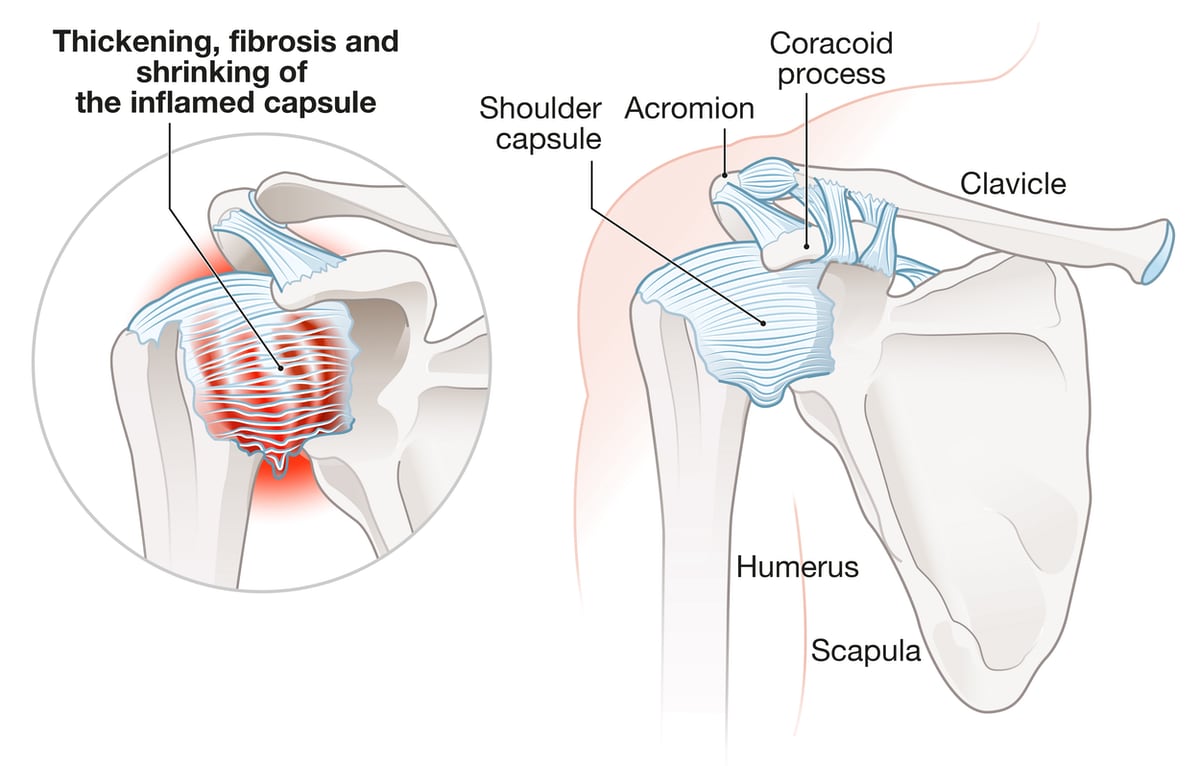
Frozen shoulder.
Some of the nerdy details
Hsieh et al randomly assigned ninety patients to one of the three injection protocols, with ultrasound-guided injections targeting both the glenohumeral joint (the main, ball-and-socket joint), plus a bursa (friction pad, subacromial-subdeltoid). Everyone got bog standard physio along with their injections. Follow-up ran to six months, with assessments at 1, 2, 4, and 6 months. Both patients and outcome judges were blinded (not the injecting physician).
The results were clear: corticosteroids were substantially superior to PRP on the primary outcome (Shoulder Pain and Disability Index) and most secondaries as well, with an obvious effect by one month and sustained to six months.
But the really damning result for PRP is that it didn’t outperform saline on any outcome. All three groups improved, which probably reflects natural history as much as treatment effect — frozen shoulder resolves on its own, and there was no untreated control.
Checking my bias
I like to see PRP lose. I am biased against PRP, and cranky about it to boot: I’m sick of it being promoted and sold to people out of all proportion to the evidence.
And so I should probably not embrace this result uncritically just because it’s what I want to hear. To be intellectually honest, I must try to see it as a PRP proponent would. And indeed they would have some justification for dismissing it. Anticipating their main nitpicks then, in an abundance of fairness…
PRP composition was never revealed: no platelet counts, no growth factor analysis, no leukocyte profiling. PRP is not a standardized drug.
All the injectates — including the PRP — contained 4 mL of 1% lidocaine mixed in. Lidocaine is cytotoxic to platelets and cells at relevant concentrations, and mixing local anaesthetic directly into PRP before injection may have compromised its biological activity. This isn’t discussed in the paper.
The study also recruited exclusively from the freezing stage, where active synovial inflammation is dominant and corticosteroids should be at their strongest advantage. By excluding the frozen and thawing stages — where PRP’s supposed regenerative mechanisms might be more relevant — the study puts PRP in its worst-case scenario.
So dismissing the result as “poor PRP” is not a frivolous objection, even if it is also a convenient one. These are real vulnerabilities.
I still do think that the result is a credible negative for PRP, believable bad news, but clearly it’s not nail-in-coffin material — so it’s a good thing it’s not alone. It’s just one imperfect data point among many. The body of evidence on this topic is damning: the best studies are the most negative, and even the most biased in favour of PRP aren’t especially impressive.
I review the topic thoroughly in my main PRP article, now updated with this citation (as is my frozen shoulder book).
The PRP-vs.-saline equivalence is the provocative finding of this study, but comes with some flaws, none of them critical. Meanwhile, the CS advantage is robust and convincing. We can say, based on this data, that steroids are better than PRP for shoulders in the freezing stage.