


How muscles rip
I recently updated my book about muscle strains with more scientific detail about the exact mechanism of hamstring strains, particularly explaining the dominant theory, and then looking at who disagrees and why. Here’s a good sneak peak behind the paywall, including 8 footnotes visible only to logged-in PainSci members. LOGIN
Most muscle tears happen during contractions that are not only eccentric, but fast and powerful.12 They are most common in sprinting, for instance, and the harder you run, the higher the risk.
The hamstrings usually tear this way, mostly in the instant before foot-strike, at the end of the “swing phase.”3 At that point in the gait cycle, the hamstrings are doing the eccentric thing: lengthening and contracting at once, putting the brakes on that forward swing, slowing the foot down before it connects with the ground.4 The biceps femoris muscle may be the most likely part of the hamstrings to rip, because it is working harder and lengthening just a little more — a quirk of anatomy, accentuating the eccentric contraction — than the other “strings” (semitendinosus and semimembranosus).5
Settled science? Mature kinesiology? Probably … not! All those citations are getting pretty old, and research has continued. The late-swing-phase hypothesis was questioned by Van Hooren and Bosch in 2018,6 Maybe injury happens a split second later, due to “large joint torques and ground reaction forces during early stance” — although “direct evidence is still lacking” (as of 2019).7
I followed that with a re-write of a short chapter about the role of movement mistakes in muscle strain: “Movement mistakes and micro-clumsiness: zigging when you should have zagged.” It was always tiny and basic, not really worthy of being called a “chapter.” (I used to call them “sections,” back in the day, when were all much shorter on average.) I probably hadn’t even looked at that particular chunk of text in a decade. But there was a good idea at the heart of it, and that idea has now been expressed more clearly and thoroughly than my original attempt: a "chapter" at last! Albeit still a short one. Here’s some of it:
You could certainly make a case that our wise bodies should “know” better than to ever contract too hard while a muscle is lengthening (eccentric contraction) — and there are indeed dazzlingly intricate reflexes that prevent exactly that, of course, and they mostly work extremely well.
Yes, yes, very impressive … but we are also a species that stubs our toes on the regular. 😜
Movement mistakes happen. Sometimes we zig when we should have zagged! Sometimes the intricate reflexes fail because we made a poor split-second “decision.”8 I speak from plenty of experience as a somewhat clumsy “athlete” (mostly retired now). I suspect many coordination mistakes involve conflicting coordination priorities — quite literally trying to do two things at once (at least), to the detriment of both. I speculate that this is one of the major basic reasons why the intricate orchestration of the sprinting muscles sometimes produces a sour note, and occasionally just fails catastrophically.
Not subtle, technical, kinesiological vulnerabilities (like the “pelvic misalignment” of Oleksy et al). I suspect the unsubtle elephant in the room is mostly just … “clumsiness.” A citation to support this idea would be great, of course, but I don’t have one of those.
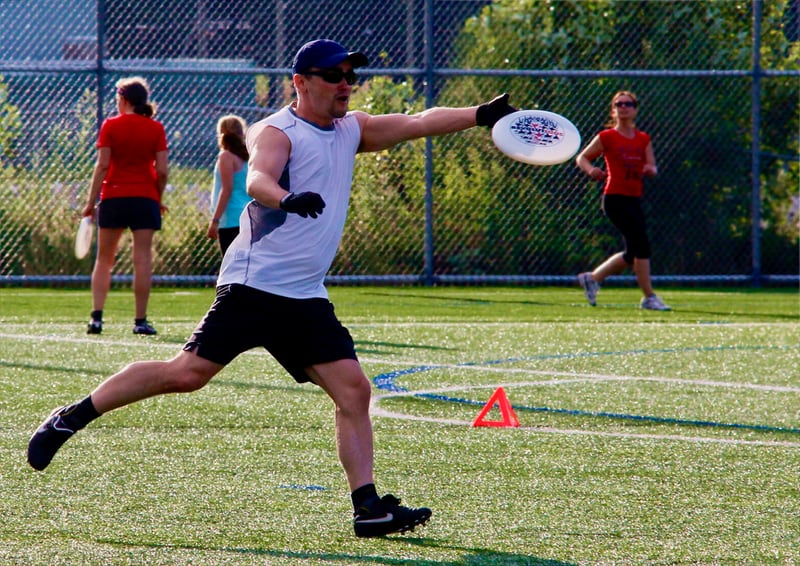
That’s me playing ultimate about twenty years ago — coordinating a lot of fast, powerful muscle contractions, mostly without injury. But not always! I think I probably had about a half dozen mild to moderate muscle strains in my 25-year ulti career.
Notes
- Bahr R, Mæhlum S. Clinical guide to sports injuries. Human Kinetics; 2004. “Strains usually occur at the myotendinous junction during a bout of maximal eccentric exercise.”
- Orchard JW, Alcott E, James T, et al. Exact moment of a gastrocnemius muscle strain captured on video. Br J Sports Med. 2002 Jun;36(3):222–223. PubMed 12055121 ❐ A few years ago, this paper was published about a cricket player whose calf rupture was recorded on video, showing the tear occur exactly at this moment when “the gastrocnemius complex was moving from an eccentric to an isometric phase.”
- Schache AG, Wrigley TV, Baker R, Pandy MG. Biomechanical response to hamstring muscle strain injury. Gait Posture. 2009 Feb;29(2):332–8. PubMed 19038549 ❐
- Schache AG, Dorn TW, Blanch PD, Brown NAT, Pandy MG. Mechanics of the human hamstring muscles during sprinting. Med Sci Sports Exerc. 2012 Apr;44(4):647–58. PubMed 21912301 ❐
- Heiderscheit BC, Hoerth DM, Chumanov ES, et al. Identifying the time of occurrence of a hamstring strain injury during treadmill running: a case study. Clin Biomech (Bristol). 2005 Dec;20(10):1072–8. PubMed 16137810 ❐
- Van Hooren B, Bosch F. Is there really an eccentric action of the hamstrings during the swing phase of high-speed running? part I: A critical review of the literature. J Sports Sci. 2017 Dec;35(23):2313–2321. PubMed 27937671 ❐ The authors hypothesize that the elastic parts of the muscle could lengthen while the contractile element continues to shorten while contracting — isometric rather than eccentric. It’s a very technical and speculative argument based on modelling, but worth considering.
- Kenneally-Dabrowski CJB, Brown NAT, Lai AKM, et al. Late swing or early stance? A narrative review of hamstring injury mechanisms during high-speed running. Scand J Med Sci Sports. 2019 Aug;29(8):1083–1091. PubMed 31033024 ❐
- Many such “decisions” are too fast and somatic to be considered “deliberate” or even conscious, but by no means all. I can recall many occasions when I knew full well that I was, say, sprinting all out to catch a disc but then also tried to suddenly brake and swerve to avoid a defender, and the competing impulses were challenging and awkward — sprint or brake?! in what proportions?! Countless incidents like that were extremely subtle and ephemeral, and yet I did still know about them. But there are probably many more such awkward athletic moments that were entirely subconscious, or just so muddled that I couldn’t really even tell what was happening. I glitched athletically on the field countless times, usually when tired, and in most cases I couldn’t begin to tell you exactly which competing impulses got tangled up.