


Brains in pain: microglial maps in rats
What if your brain was changed by a butt injury? And what if it kept changing? New evidence shows this happening in rats: clear changes in their little brains that evolve for a month while their sciatic nerves are tortured. This is “neat” science if nothing else, but I’ll try to extract something useful from this neurology news.
(It’s not useful or neat for the rats! As always, we are grateful to the rats for their sacrifice. Thank you, rats: you are lovely little critters, despite your naked tails. We truly regret that you suffer so that primates can try to understand biology better.)
Micro microglia primer
Rat brain changes were observed in microglial cells. “Glial” cells are all the brain’s support cells collectively, like the astrocytes, oligodendrocytes, and ependymal cells. Micro-gial cells are the immune-derived glial cells. Microglia are glia, but not all glia are microglia. They largely stay put, but have long and dynamic arms. Creepy.
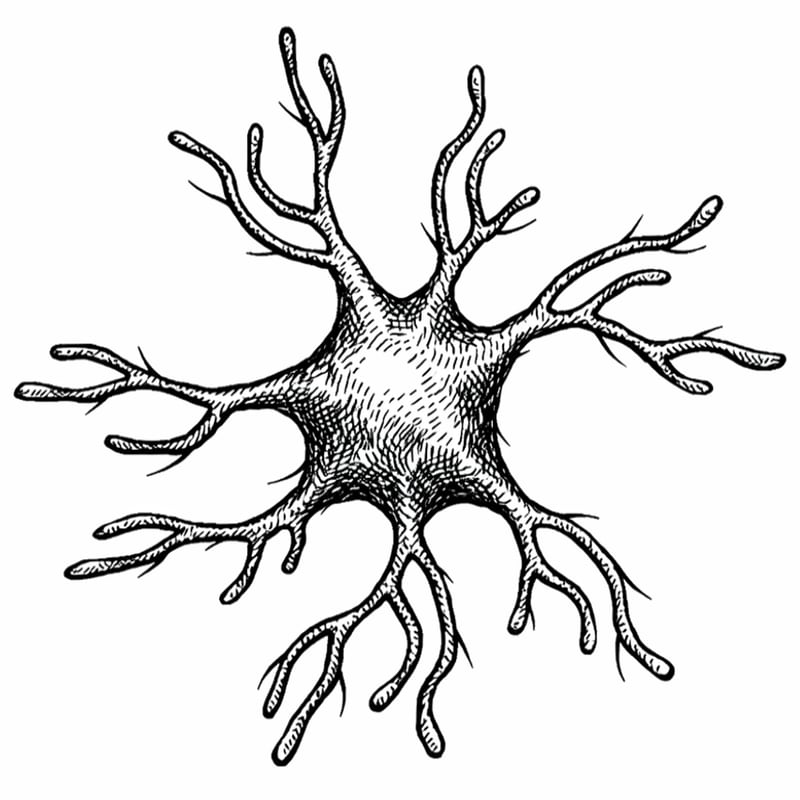
Artistic representation of a typical microglial cell. They are very hard to image — not particularly photogenic! Mostly just low-resolution blobs, like this. [Wikimedia] Those arms are always moving, and can extend up to several times the width of the cell body, over a few minutes. This is a modified version of an image by Microsome, CC BY 3.0, via Wikimedia Commons.

Microglial cells patrol neural tissue like cop-janitor hybrids, and there are billions of them in the brain, roughly one for every 10 neurons — like if 10% of people were heavily armed sanitation professionals. They aren’t neurons, but they work with them extremely closely, and probably affect many aspects of brain function. They’re sensitive to signals from both brain and body, which may explain why systemic inflammation can fog your thinking. They have many jobs: pruning unnecessary synapses during development, clearing cellular debris, responding to infections and traumas.
Like most immune cells, microglia come with trade-offs. You don’t want them to be too active for too long. Which is why this research was a little troubling!
Rat brain changes with sciatica mapped in detail
And now back to today’s science. Here’s the full citation:
Cazuza RA, Laoumtzis M, Lacagnina MJ, et al. Brain-wide changes in microglial morphology following peripheral nerve injury. J Pain. 2026 Jan;38:105582. PubMed 41109469 ❐
Cazuza et al. mapped how microglia in the brain change their shape after nerve injury, which is a proxy for how “activated” or inflamed they are. They induced sciatica with squeezing, and then examined 52 different brain regions at 7 and 28 days afterward, using automated software to measure microglial shape changes at scale. This was quite ambitious.
Microglial activation wasn’t confined to pain-sensing areas: it showed up across brain regions involved in emotion, cognition, motivation, and stress regulation.
This isn’t especially surprising: we’ve known for more than 20 years that microglia react to injuries out in the body, although the majority of that research has focused on the spine. What’s new here is the high-resolution wide-angle view of the brain over time, producing the big takeaway: the pattern of microglial activation shifted as the pain dragged on.
At day 7, the activation action was in the motor cortex.
But by day 28? The shape-shifting shifted to the hypothalamus and reward circuitry — regions associated with stress, sleep, and motivation. All of which are commonly disrupted in chronic pain patients.
Neurology “news you can use”? Reaching for why microglia might matter
But … “in rats.” Animal models aren’t great. Shape-shifting rat microglia don’t necessarily mean functional change; activated-looking cells aren’t necessarily doing what we assume, and we know that rodent and human microglia are not identical. Microglial research is one of the best examples of pain science that’s intriguing for nerds, but does little for people in pain. But it is neat to know that the brain measurably changes as pain drags on, and here are a few possible practical ramifications:
- If microglial botheration can spread, it might explain why chronic pain often comes with depression, insomnia, and brain fog — and suggests the need to treat those downstream effects of pain, if the pain itself can’t be relieved.
- It punctuates the value of timely and competent diagnosis, leading to any possible relief from the pain — because pain isn’t “just” pain. It has complications!
- It hints that it might be important not to wait for a new pain to become chronic before taking it seriously (“come back and see me again if this doesn’t go away” might be bad advice).
- It suggests that even “ineffective” and “temporary” treatments that “mask” pain might actually have value: they could prevent the spread of microglial arousal. Just because pain causes brain changes doesn’t mean analgesia can prevent or reverse them, but it’s a thread worth pulling on.
- It might be a particularly good reason not to push your luck with “powering through” painful problems — which is especially straightforward in the case of overuse injuries.