


Strengthening helps plantar fasciitis
Three pages on PainSci cite Rathleff 2015: 1. The Complete Guide to Plantar Fasciitis 2. Guide to Repetitive Strain Injuries 3. Exercise is anti-inflammatory medicine for injuries (Member Post)
PainSci commentary on Rathleff 2015: ?This page is one of thousands in the PainScience.com bibliography. It is not a general article: it is focused on a single scientific paper, and it may provide only just enough context for the summary to make sense. Links to other papers and more general information are provided wherever possible.
Raise a little heel 🎶 raise a little heel 🎶 raise a little heel! If you don’t like what you got, why don’t you change it? If you know there’s something wrong why don’t you right it?
Trooper, from the classic song, “Raise a Little Heel”
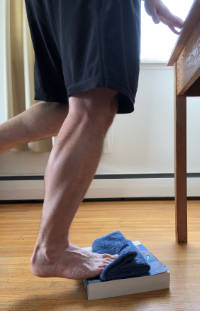
In 48 plantar fasciitis patients, Rathleff et al. compared the effect of stretching to heel raises (AKA repeatedly standing up on your tip-toes). A towel was inserted under the toes for a little extra angle. When patients were able to comfortable manage a dozen slow lifts every other day, they added weight: a backpack full of books. Elegant simplicity! They kept this regimen up for several months … but it didn’t take long to help. Although everybody got better eventually, the heel raisers got better a lot quicker than the stretchers. They were already much better off after three months.
This isn’t proof that heel raises are going to work … but it’s more than good enough to justify trying it. Obviously we’ll hope to see replication by other researchers.
original abstract †Abstracts here may not perfectly match originals, for a variety of technical and practical reasons. Some abstacts are truncated for my purposes here, if they are particularly long-winded and unhelpful. I occasionally add clarifying notes. And I make some minor corrections.
The aim of this study was to investigate the effectiveness of shoe inserts and plantar fascia-specific stretching vs shoe inserts and high-load strength training in patients with plantar fasciitis. Forty-eight patients with ultrasonography-verified plantar fasciitis were randomized to shoe inserts and daily plantar-specific stretching (the stretch group) or shoe inserts and high-load progressive strength training (the strength group) performed every second day. High-load strength training consisted of unilateral heel raises with a towel inserted under the toes. Primary outcome was the foot function index (FFI) at 3 months. Additional follow-ups were performed at 1, 6, and 12 months. At the primary endpoint, at 3 months, the strength group had a FFI that was 29 points lower [95% confidence interval (CI): 6-52, P?=?0.016] compared with the stretch group. At 1, 6, and 12 months, there were no differences between groups (P>0.34). At 12 months, the FFI was 22 points (95% CI: 9-36) in the strength group and 16 points (95% CI: 0-32) in the stretch group. There were no differences in any of the secondary outcomes. A simple progressive exercise protocol, performed every second day, resulted in superior self-reported outcome after 3 months compared with plantar-specific stretching. High-load strength training may aid in a quicker reduction in pain and improvements in function.
related content
Specifically regarding Rathleff 2015:

This page is part of the PainScience BIBLIOGRAPHY, which contains plain language summaries of thousands of scientific papers & others sources. It’s like a highly specialized blog. A few highlights:
- Long-Term Effects of Repeated Injections of Local Anesthetic With or Without Corticosteroid for Lumbar Spinal Stenosis: A Randomized Trial. Friedly 2017 Arch Phys Med Rehabil.
- Cannabis-based medicines for chronic neuropathic pain in adults. Ateş 2026 Cochrane Database Syst Rev.
- Effect of exercise on depression and anxiety symptoms: systematic umbrella review with meta-meta-analysis. Munro 2026 Br J Sports Med.
- Optimizing elastic band resistance training for Metabolic Syndrome components in older adults: A systematic review, meta-analysis, and meta-regression of randomized controlled trials. Saez-Berlanga 2026 Arch Phys Med Rehabil.
- Biomechanical insights into Achilles tendinopathy risk and protection in runners: a large prospective study 4HAIE. Jandacka 2026 Br J Sports Med.