


Nachemson’s famous (and misinterpreted) study of intradiscal pressures in various positions
Three pages on PainSci cite Nachemson 1975: 1. The Complete Guide to Low Back Pain 2. Don’t Worry About Lifting Technique 3. The misuse of a classic back diagram
PainSci notes on Nachemson 1975:
Alf Nachemson is a legend in back pain research, and unfortunately this classic paper he wrote is also one of the most misinterpreted and abused studies in the history of the field. This diagram from it specifically was widely used to demonize flexion:
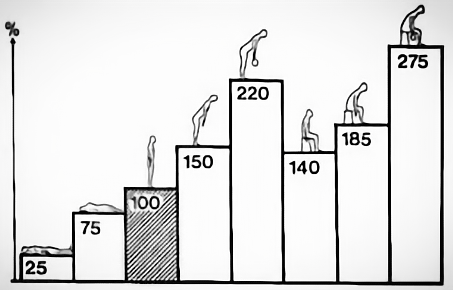
Many years later, shortly before his death, Dr. Nachemson expressed his regrets (see The Back Letter):
This experiment has been misinterpreted as evidence that the disc is a significant pain generator and that increasing the biomechanical load leads to greater pain. But this study merely showed how the lumbar spine responds to normal physiologic loading in various positions of the body. It does not give any indication as to where the pain actually comes from.
Also, some key findings were contradicted by later studies (see Wilke).
Also from Nachemson’s interview:
One of the main goals of my career has been to determine the cause of non-specific back pain. And in this I have failed. I didn’t know the origin of back pain in those days, and I don’t know now.
That's some classy humility there. It remains apt many years later, and it will probably remain so indefinitely.
original abstract †Abstracts here may not perfectly match originals, for a variety of technical and practical reasons. Some abstacts are truncated for my purposes here, if they are particularly long-winded and unhelpful. I occasionally add clarifying notes. And I make some minor corrections.
By measurement of intradiscal pressure in vitro, the hydrostatic properties of the nucleus pulposus of normal lumbar intervertebral disc were proven. The hydrodynamic properties seem to exist also in the somewhat degenerated disc, but not in the more severely deranged ones. Intravitally-performed measurements of disc pressure over the last 20 years in more than 100 individuals have demonstrated how the load on the lumbar disc varies with the position of the subject's body and during the performance of various tasks, both in standing and in sitting. Compared with the pressure of load in the upright standing position, reclining reduces the pressure by 50-80%, while unsupported sitting increases the load by 40%, forward leaning and weight lifting by more than 100%, and the position of forward flexion and rotation by 400%. Large augmentations in pressure were also observed in subject performing various commonly prescribed strengthening exercises.

This page is part of the PainScience BIBLIOGRAPHY, which contains plain language summaries of thousands of scientific papers & others sources. It’s like a highly specialized blog. A few highlights:
- Long-Term Effects of Repeated Injections of Local Anesthetic With or Without Corticosteroid for Lumbar Spinal Stenosis: A Randomized Trial. Friedly 2017 Arch Phys Med Rehabil.
- Cannabis-based medicines for chronic neuropathic pain in adults. Ateş 2026 Cochrane Database Syst Rev.
- Effect of exercise on depression and anxiety symptoms: systematic umbrella review with meta-meta-analysis. Munro 2026 Br J Sports Med.
- Optimizing elastic band resistance training for Metabolic Syndrome components in older adults: A systematic review, meta-analysis, and meta-regression of randomized controlled trials. Saez-Berlanga 2026 Arch Phys Med Rehabil.
- Biomechanical insights into Achilles tendinopathy risk and protection in runners: a large prospective study 4HAIE. Jandacka 2026 Br J Sports Med.